 AED 150
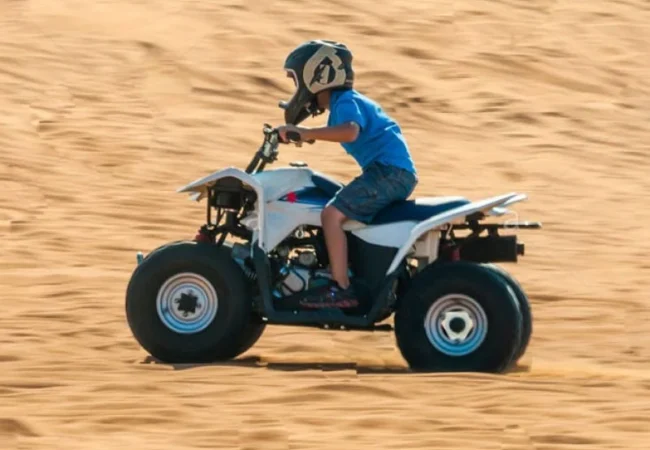
Yamaha 90cc — kids
- Ages 9–12
- Supervised
- Own track
A closed loop set apart from the open dunes, made just for this age group, with a guardian watching from start to finish and the throttle capped low.
Book this quad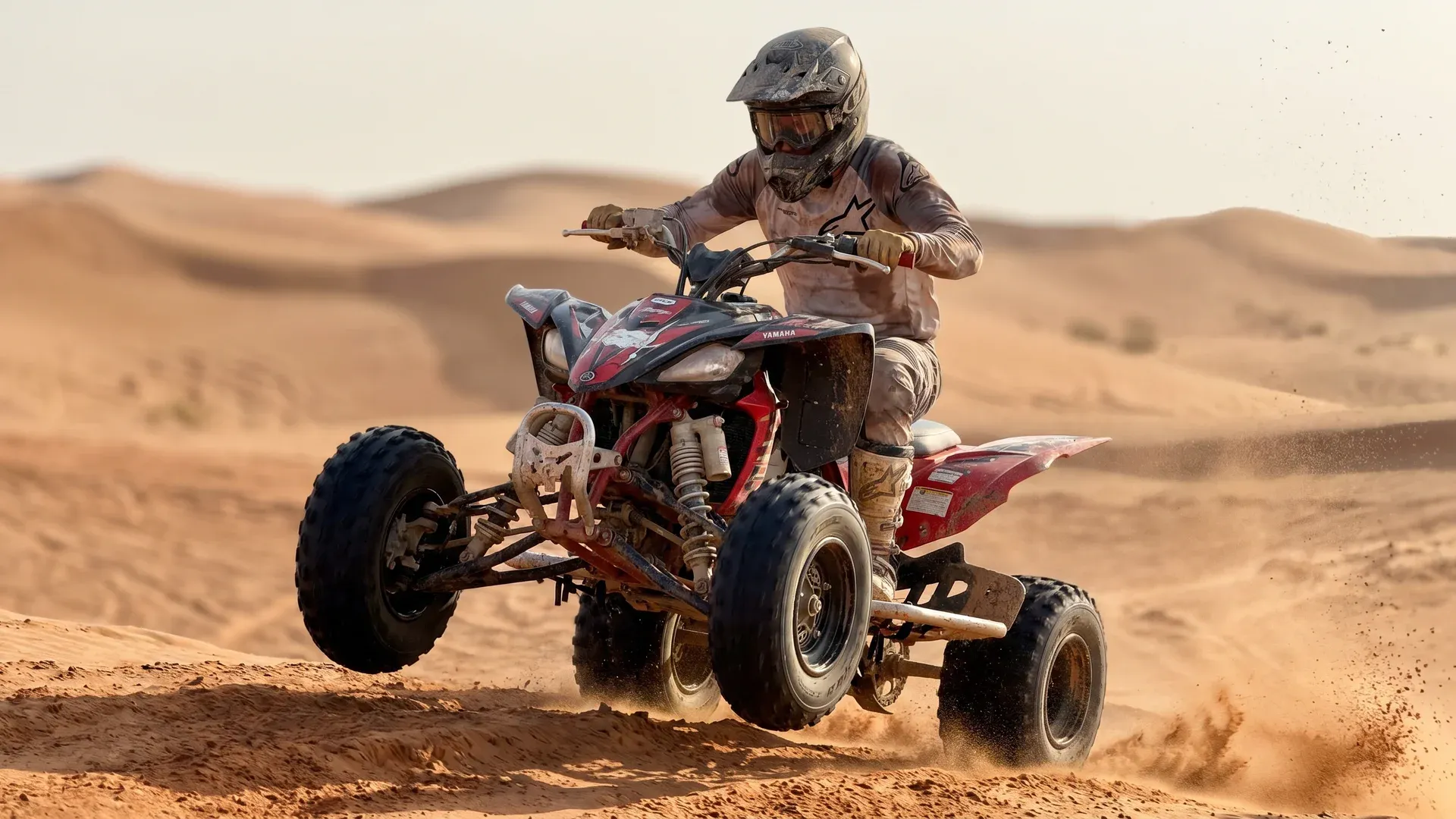
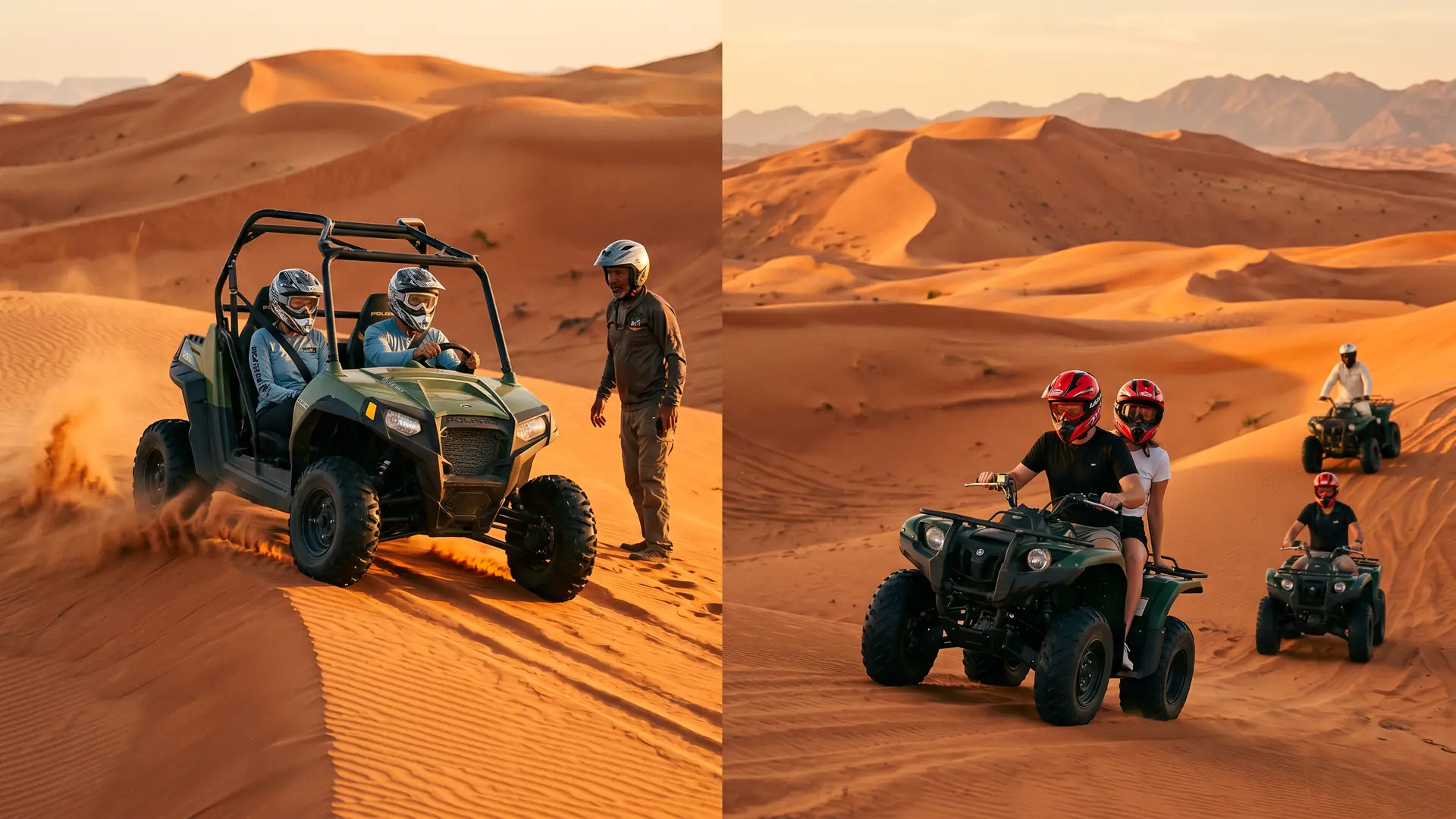
Quad biking means one machine, one rider, and a throttle that's entirely yours. No instructor sharing the controls, no back seat. Here that machine is a Yamaha, the ground is the red sand at Al Lahbab, and a lead rider sets the pace so you're never guessing which line to take next. Machines range from a closely supervised 90cc built for children through to the Raptor 700cc, saved for riders who've already proven they can handle it.
Quad biking is riding your own ATV instead of sitting in someone else's vehicle, and at Al Lahbab that means eight Yamahas to pick between, about 45 minutes southeast of Downtown Dubai. The 220cc is the easiest starting point at AED 200, the 400cc at AED 250 carries most of the bookings, and the Raptor 700cc tops the range at AED 795 for riders who've earned it. A supervised 90cc loop covers riders nine to twelve years old at AED 150. Every rider gets a helmet, cold water, a proper briefing and a guide out front reading the dunes for you.
Every quad price is per rider, since it's one person to a machine, and the 400cc double breaks that rule on its own, seating two people for one combined charge instead. Nothing is charged until your slot is confirmed on WhatsApp.
| Machine | Who it is for | From |
|---|---|---|
| Yamaha 90cc | Ages nine to twelve on a marked track, guardian on site the whole time. | AED 150 |
| Yamaha 220cc | Where most people start. Light steering, throttle that forgives a clumsy hand. | AED 200 |
| Yamaha 400cc | The one guides quietly steer most riders toward. Enough torque to climb without perfect form. | AED 250 |
| Yamaha 400cc double | One machine, two seats, billed once. For a partner who'd rather ride pillion. | AED 350 |
| Yamaha 400cc turbo | Same chassis you already know, with real shove once the throttle opens. | AED 350 |
| Yamaha Grizzly 450cc | Built for distance, not speed. Planted on broken ground and longer loops. | AED 450 |
| Sports quad 625cc | Sharper and lighter, and it notices lazy body position immediately. | AED 700 |
| Yamaha Raptor 700cc | The quickest machine in the fleet, and the only one with a chat before you get the keys. | AED 795 |
Forget engine size as your starting point. The real question is whether you've controlled a throttle before, motorbike, jet ski, anything with a twist grip. Answer that first and the right machine picks itself.
AED 150A closed loop set apart from the open dunes, made just for this age group, with a guardian watching from start to finish and the throttle capped low.
Book this quad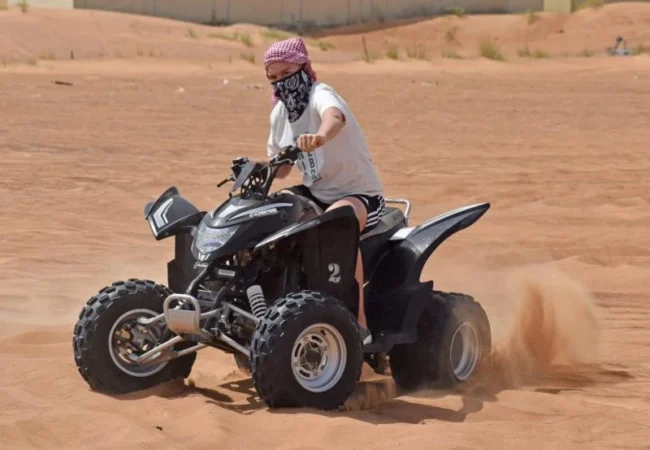 AED 200
Never controlled a throttle before? Start here. Everything happens slowly enough to think between moves, and the machine is light enough to correct the moment a line goes wrong.
Book this quad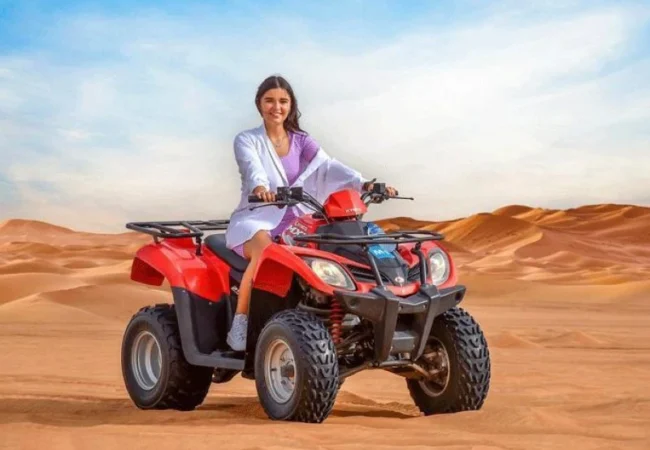 AED 250
Guides steer most riders toward this one without being asked. There's enough torque to power up a soft dune face even before your technique is fully there.
Book this quad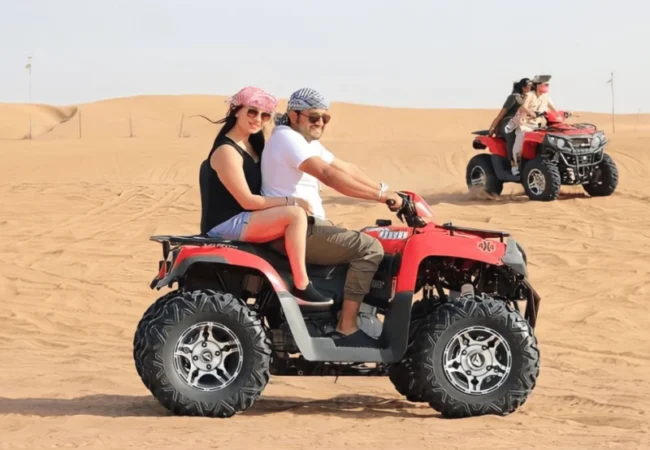 AED 350
One machine, two people, a single price. Works well when only one of you actually wants a hand on the throttle.
Book this quadAED 350Riders who've already done a standard 400cc session tend to ask for this one on the next visit. Same handling you already trust, with real punch when you open it up.
Book this quad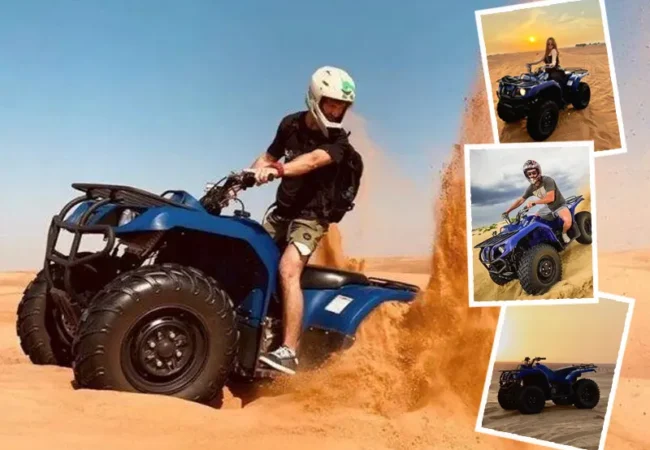 AED 450
A working machine rather than a sporty one, and it sits planted over rough ground. Worth requesting specifically once your route stretches past the standard loop.
Book this quad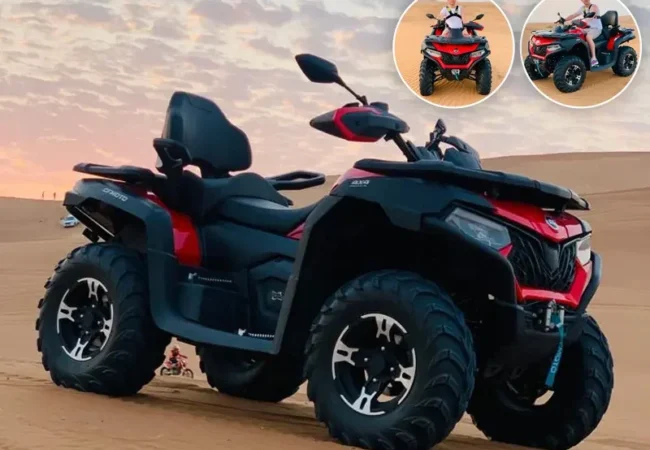 AED 700
Light, sharp, and quick to punish a rider who's leaning the wrong way. Satisfying if you already ride. Tiring fast if you don't.
Book this quad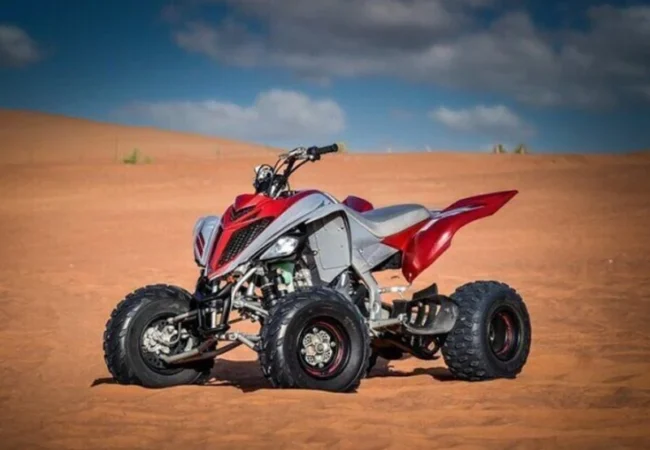 AED 795
Nothing else here moves as quick, and it's the only machine that comes with questions attached first. Answer them honestly.
Book this quadA Land Cruiser safari and a camp dinner both layer onto an ATV session, separately or combined. Add either one and a single booked hour tends to grow into most of an evening.
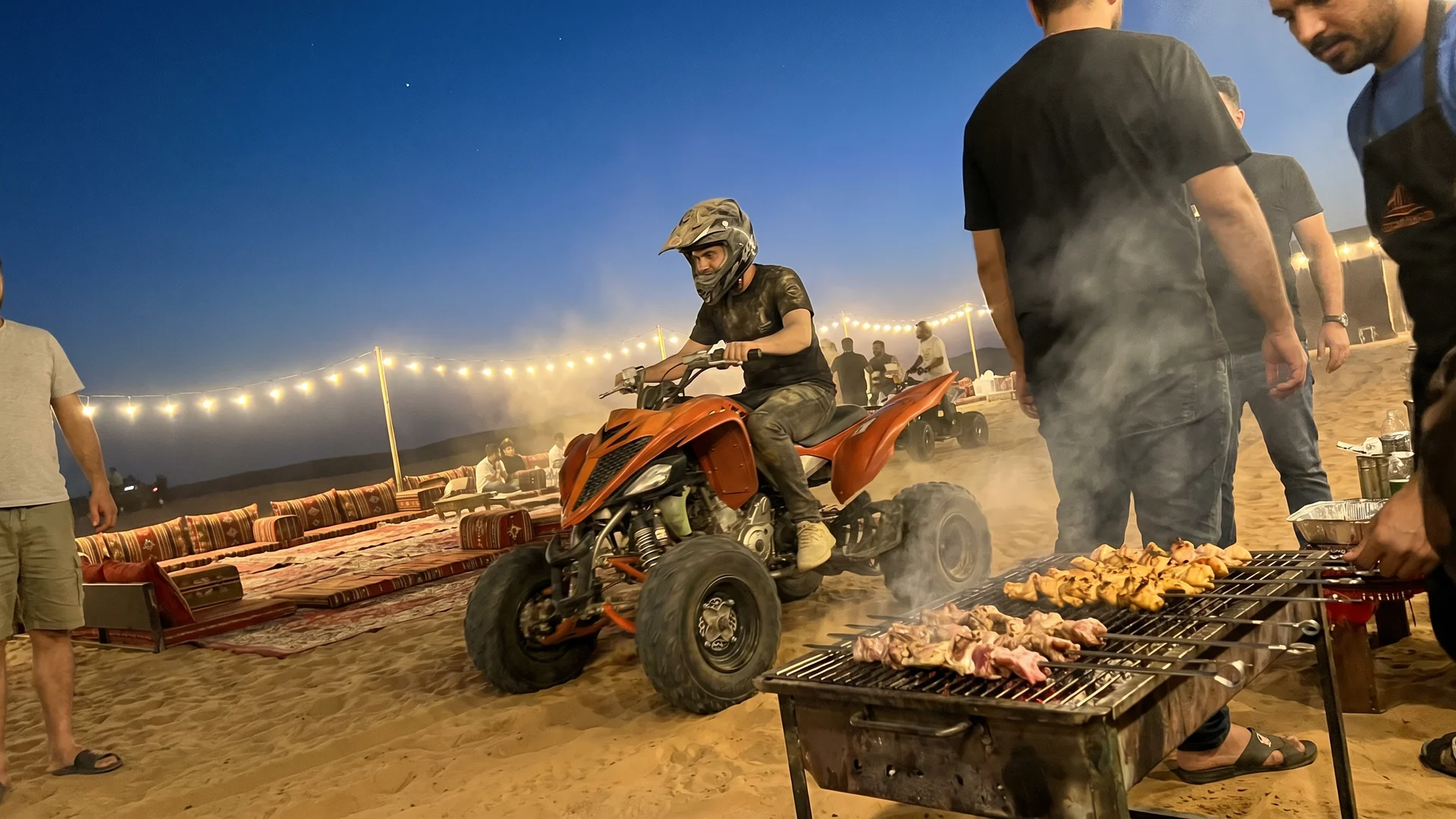 AED 375
Dune bashing behind a Land Cruiser windscreen, your own machine once you arrive, a sunset camp waiting after. Nothing else on this page gets booked more often.
Book this combo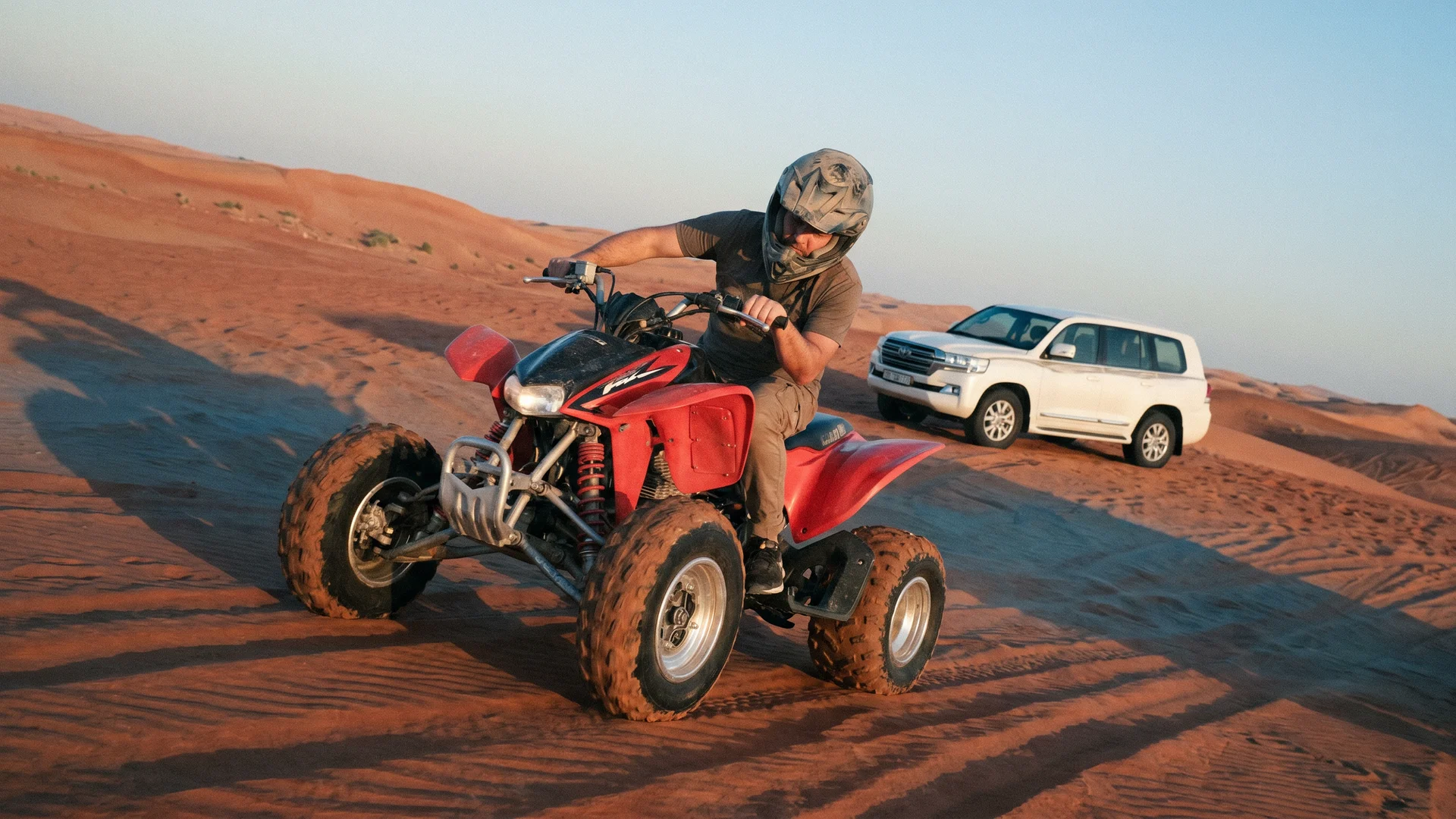 AED 290
Overnight sand still firm, dunes quieter, the whole outing wrapped up before the day heats up. The one to choose in summer.
Book this combo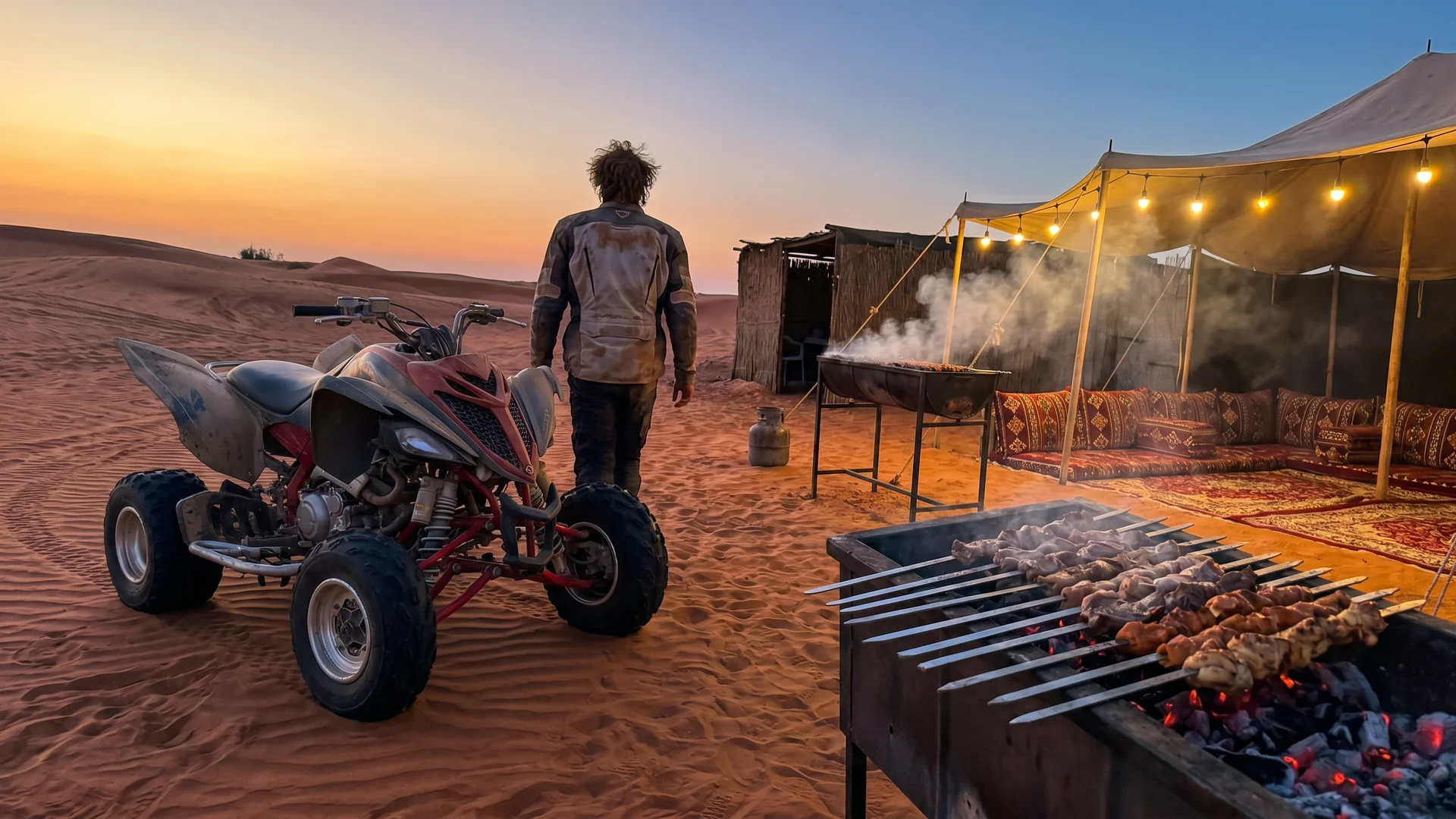 AED 700–1,300
The ride and the dinner, minus the 4x4 leg. What moves the price is the machine you choose, not what's on the plate.
Book this combo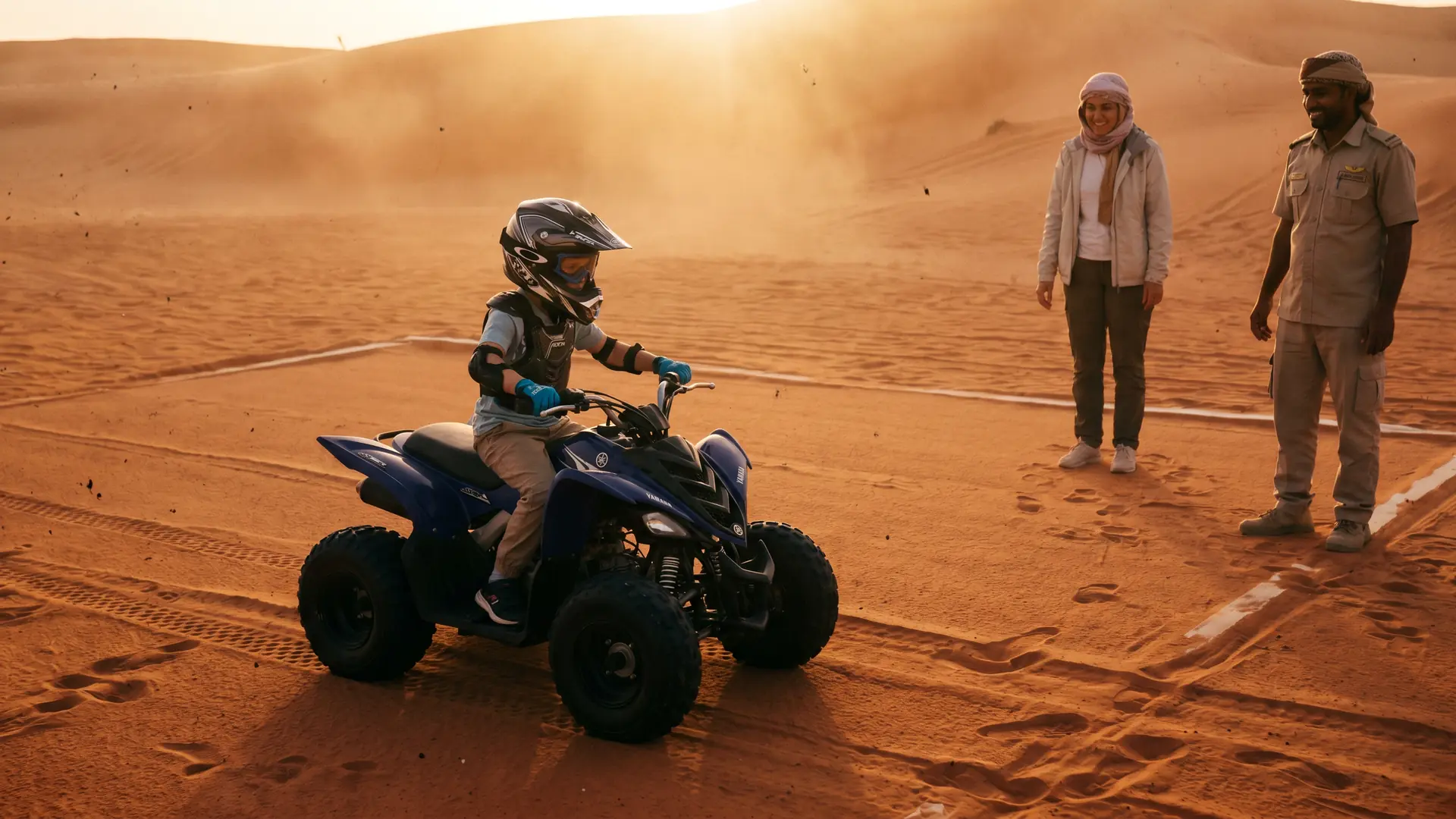 AED 150
Children loop the 90cc track while the adults take the dunes, same site, same afternoon. Everybody's on a machine, nobody's waiting in the car.
Book a family sessionNot a car. Something with a twist-grip throttle: a motorbike, a jet ski, even a smaller quad somewhere else.
Mixed groups show up here more often than solo riders do.
Think of a buggy as the same concept with doors and a windscreen mentality: a cage around you, a wheel in your hands instead of grips, seats for company. Plenty of riders book both in the same visit.
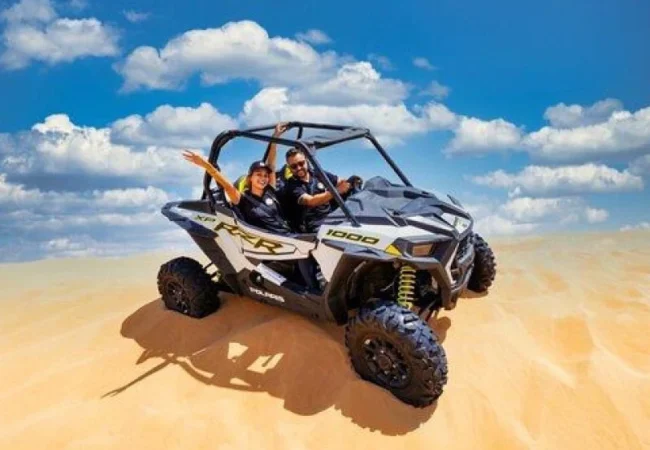
The easiest buggy to get along with. Predictable, easy to read, forgiving when your line isn't.
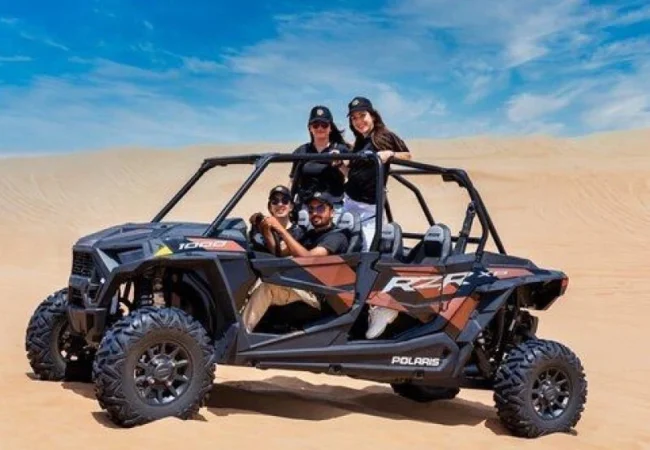
One driver, four harnesses, a single bill. The cheapest way to do this per person in a group.
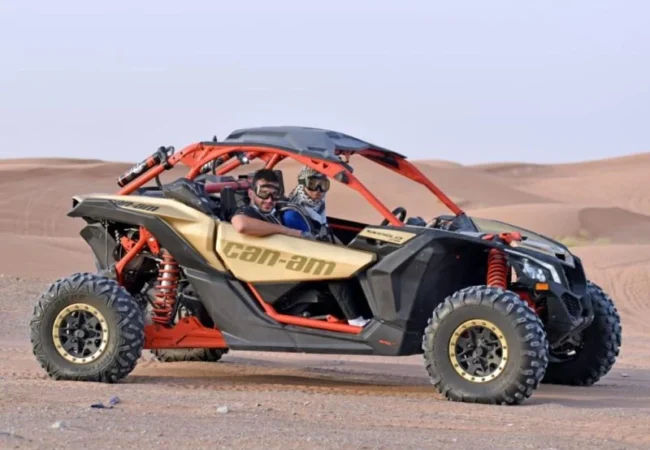
It plants wider and travels longer through the suspension, staying settled where a lighter buggy would skip.
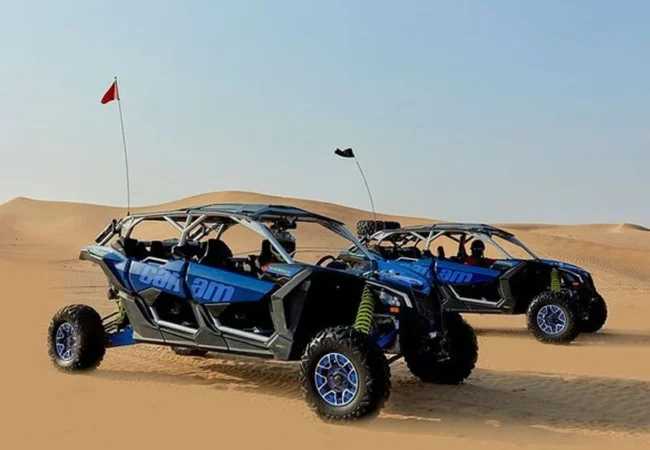
200 horsepower behind the wheel, and nothing else here puts four people over a ridge line quicker.
This is the only booking on the page that starts with a quick screening call. Two wheels expose bad habits that four wheels simply absorb, and a KTM has no interest in compensating for a rider who hasn't done this before.
AED 225 gets a seat in a Land Cruiser safari. Even if a quad's why you're here, it's worth a look, since roughly half of most groups end up preferring the passenger seat.
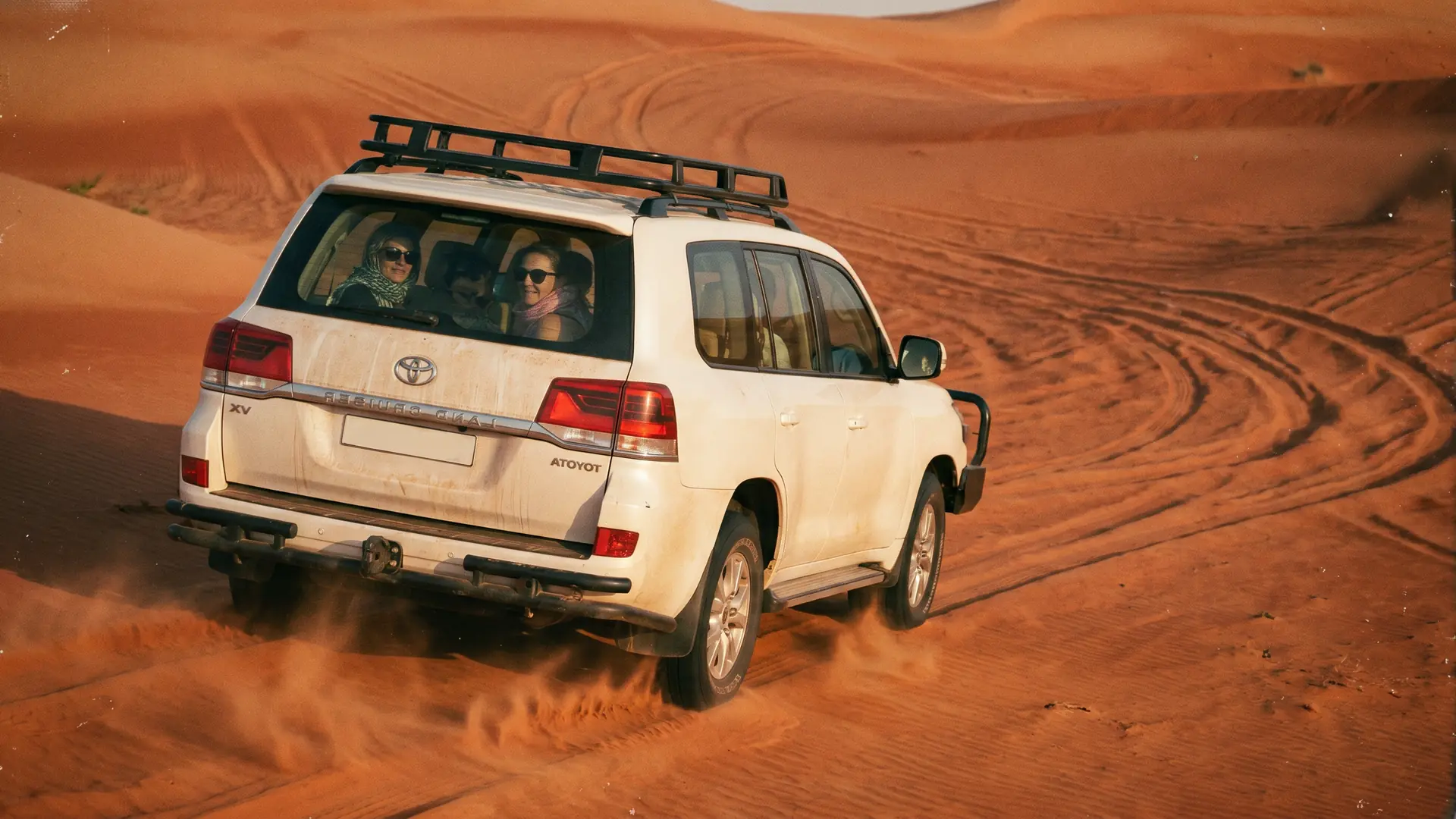
An early pickup while the sand's still firm from overnight, home again well before lunch.
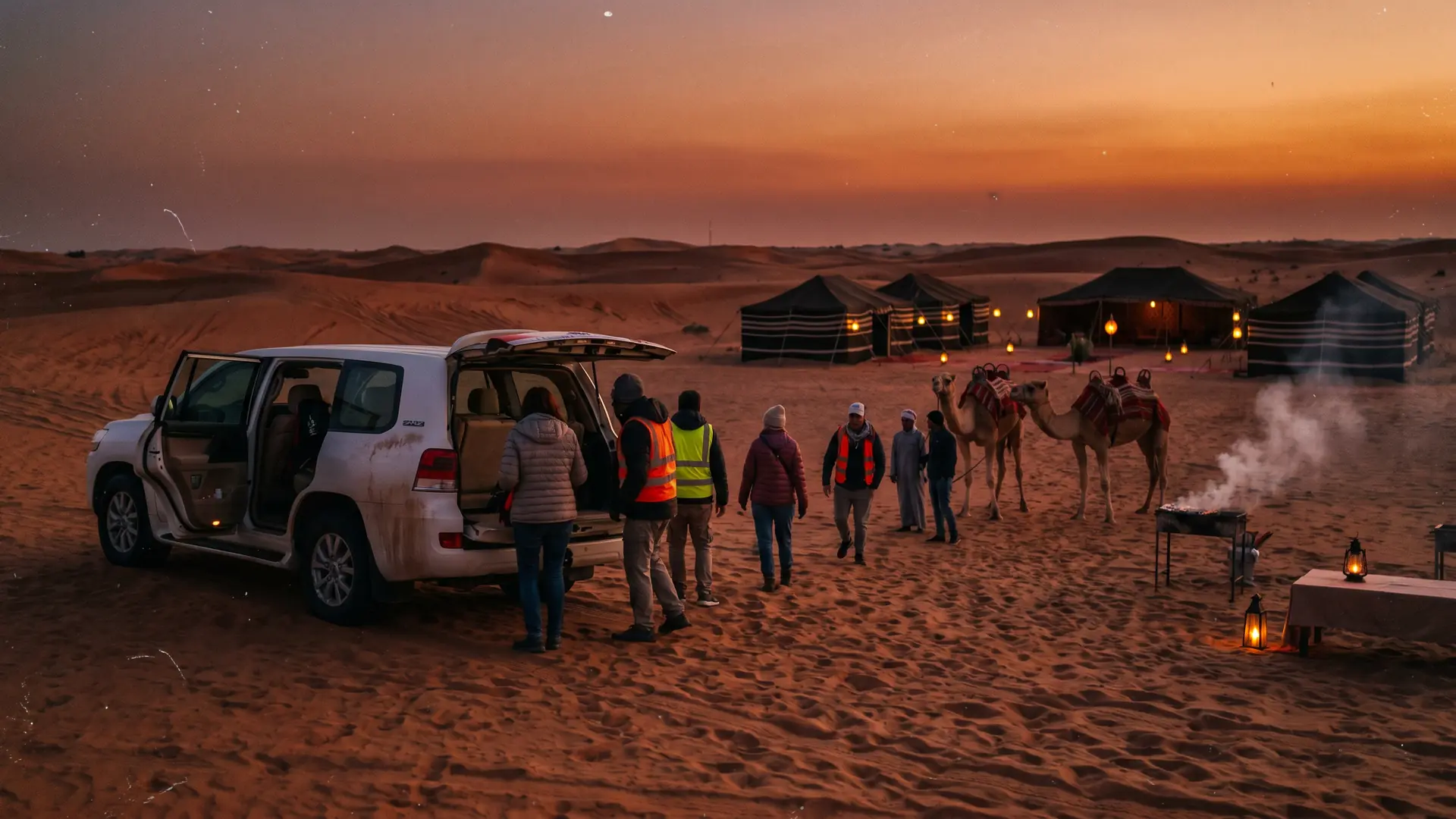
Dune bashing into a sunset camp, halal BBQ waiting, transfers covered both ways.
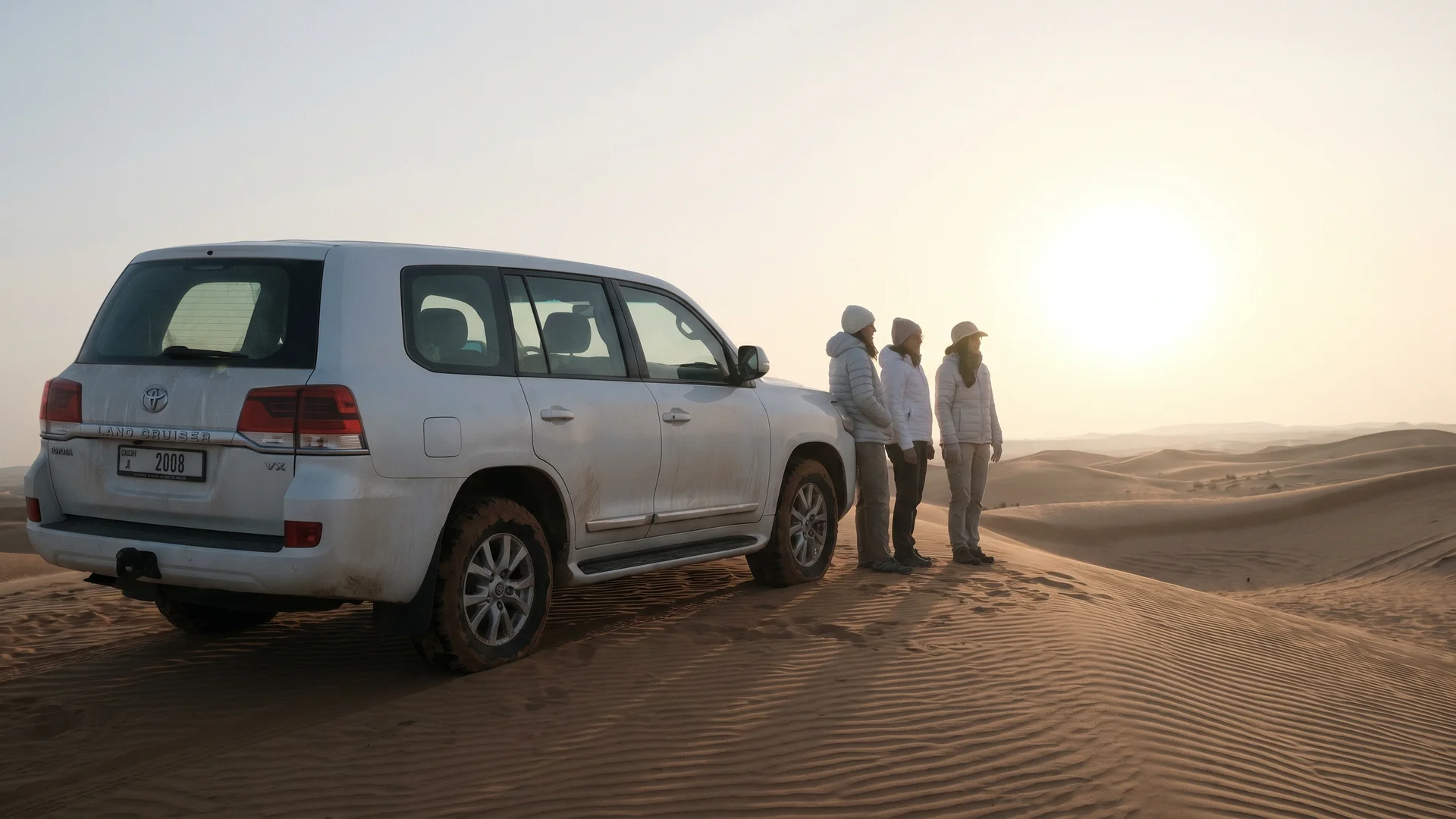
Your own 4x4 and your own guide. No shared seats, no waiting on anyone else's group.
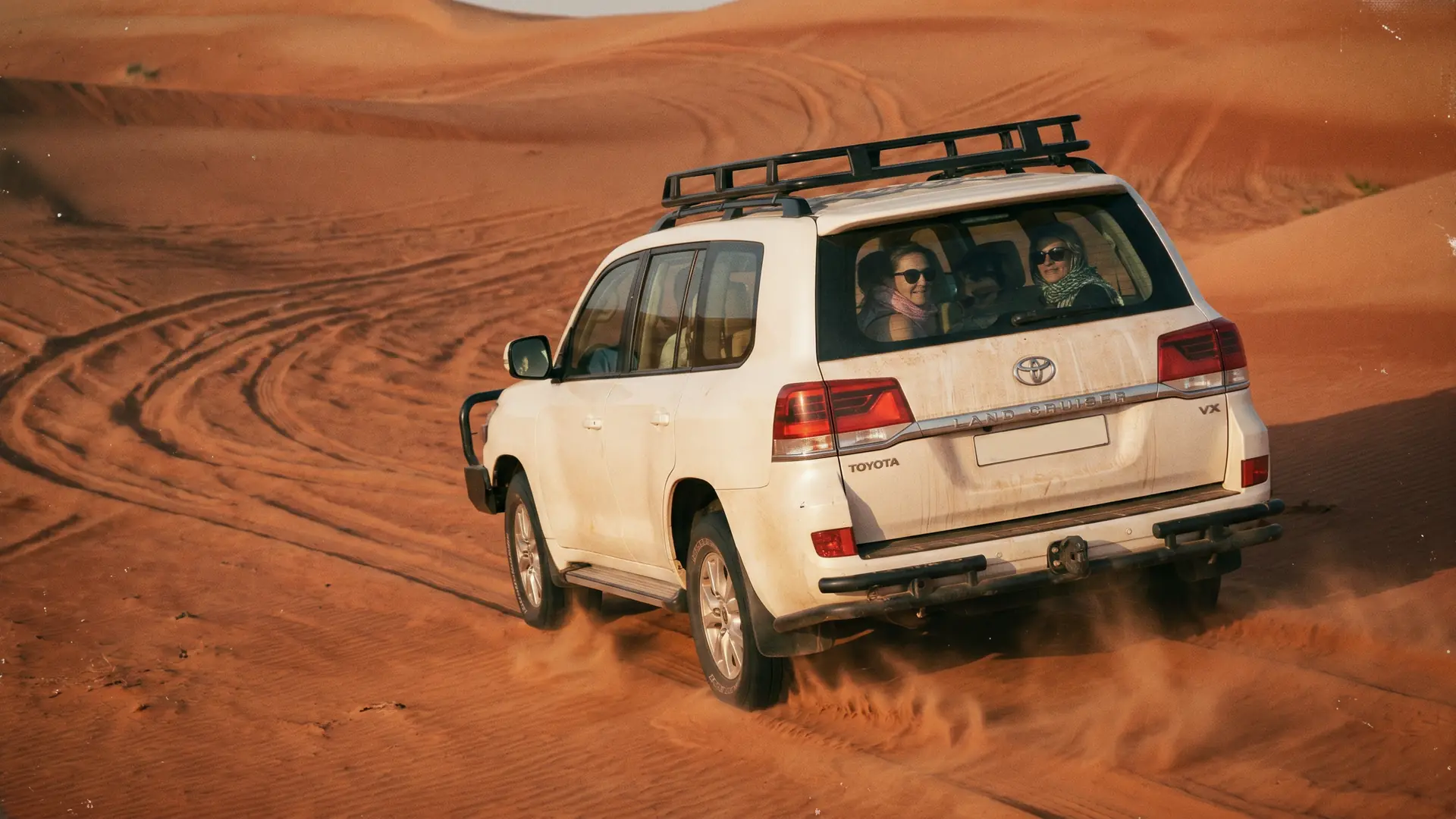
A private vehicle on its own route, dinner waiting at the camp just for you.
Overnight camping, VIP setups, corporate outings, family bookings and a gentler route without dune bashing can all be arranged. Message the details on WhatsApp and it gets shaped around whoever's in your group.
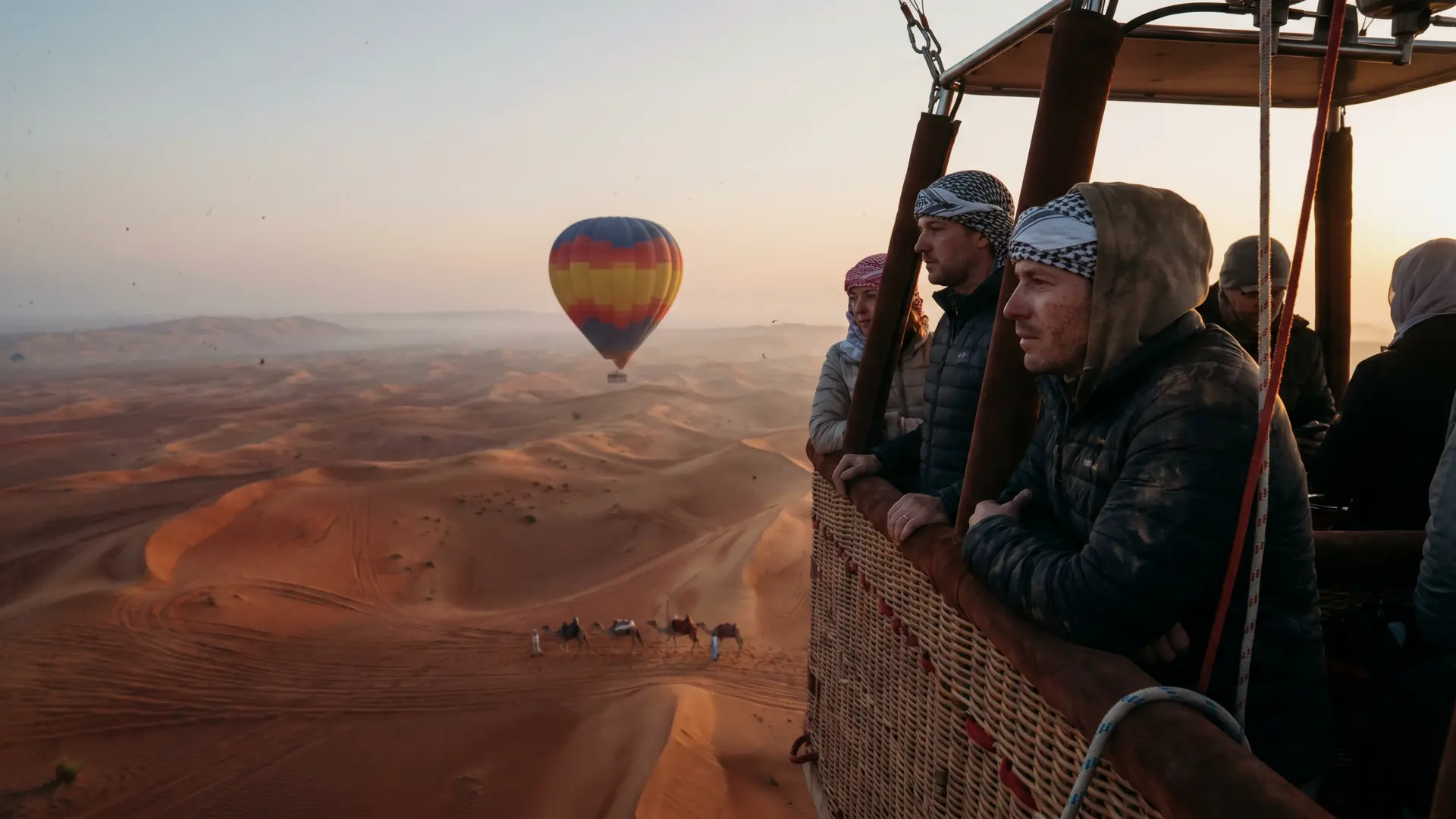
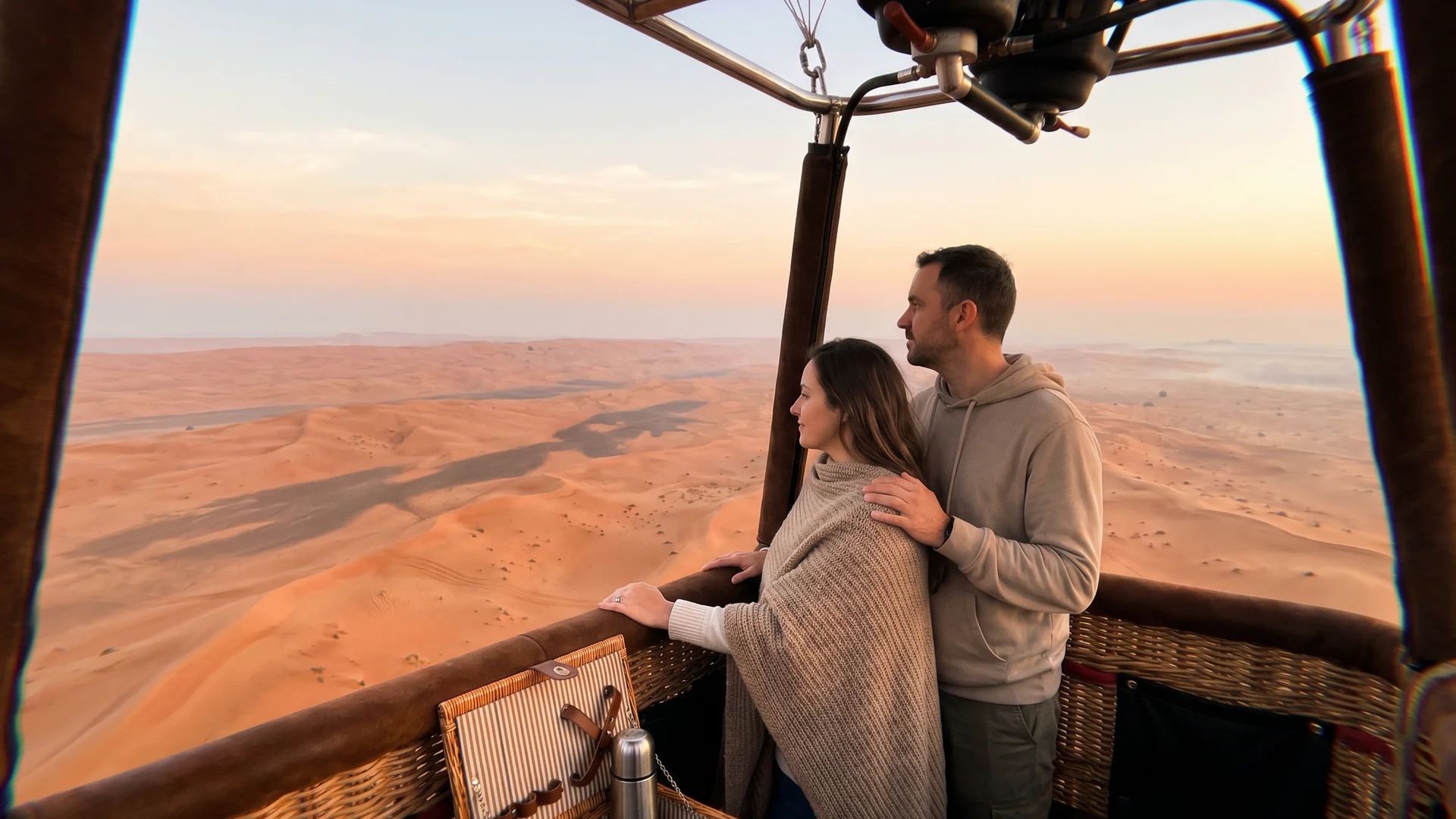
Sunrise flights above the dunes, weather allowing. The window for this runs roughly September into May, and no other booking on this page depends on clear skies quite as heavily.
For the younger ones, the grandparents, or anyone who eyed the Raptor and decided against it. The sand doesn't change, only the speed does.
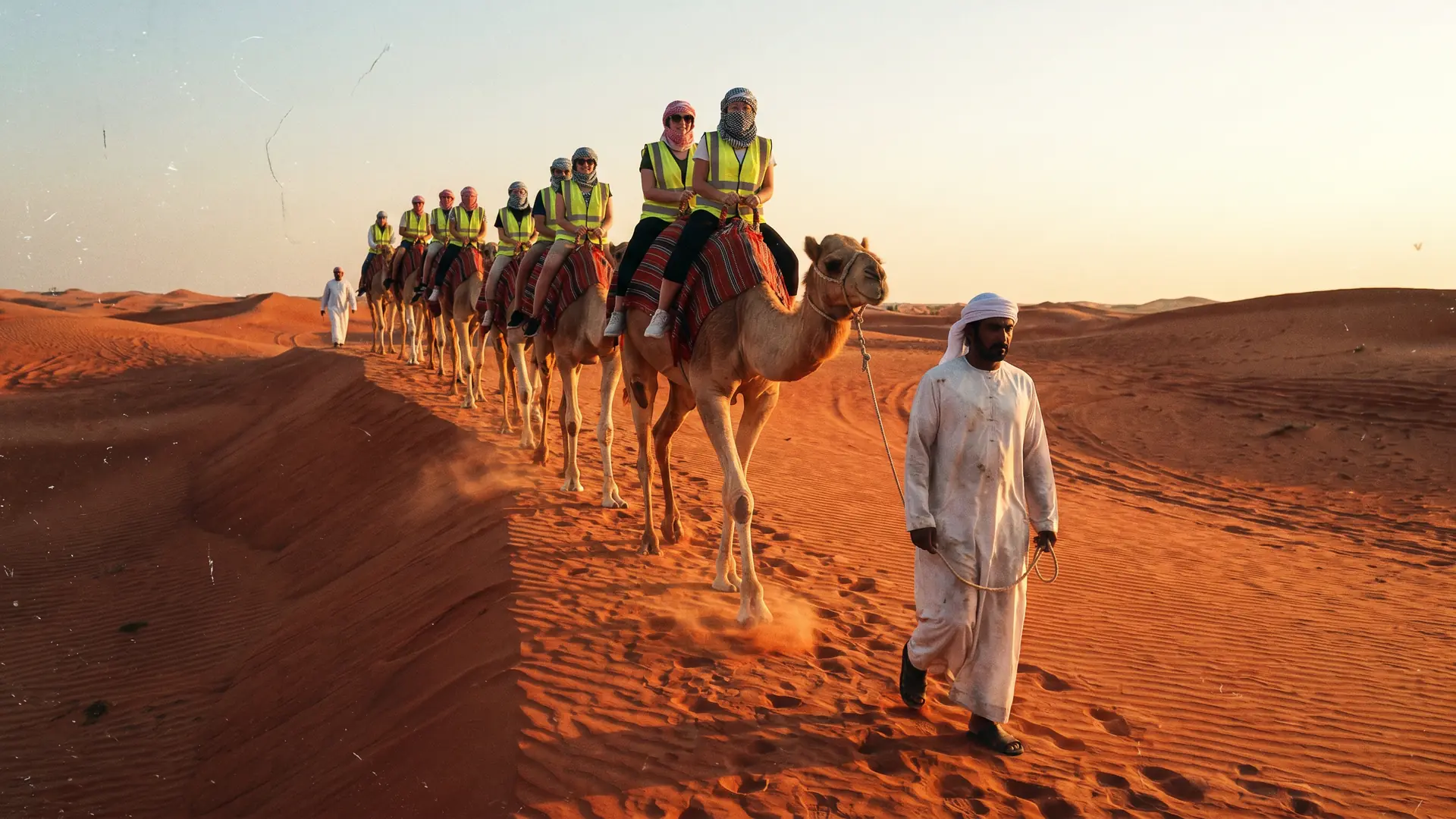
A slow, guided walk across the dunes. Kids as young as three can join if an adult's riding along.
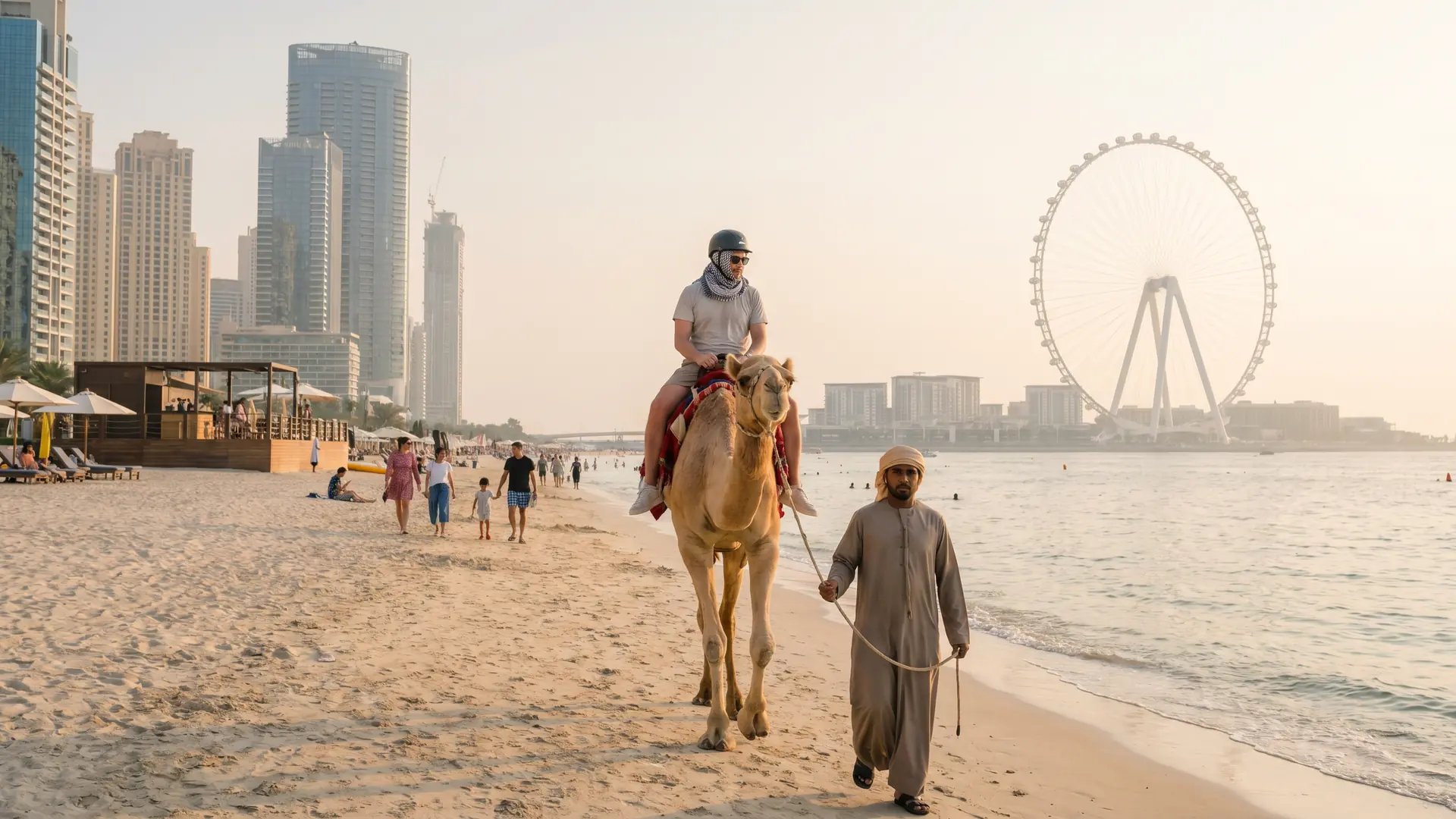
On the sand at JBR beach, skyline right behind you. This is the photo most people actually came for.
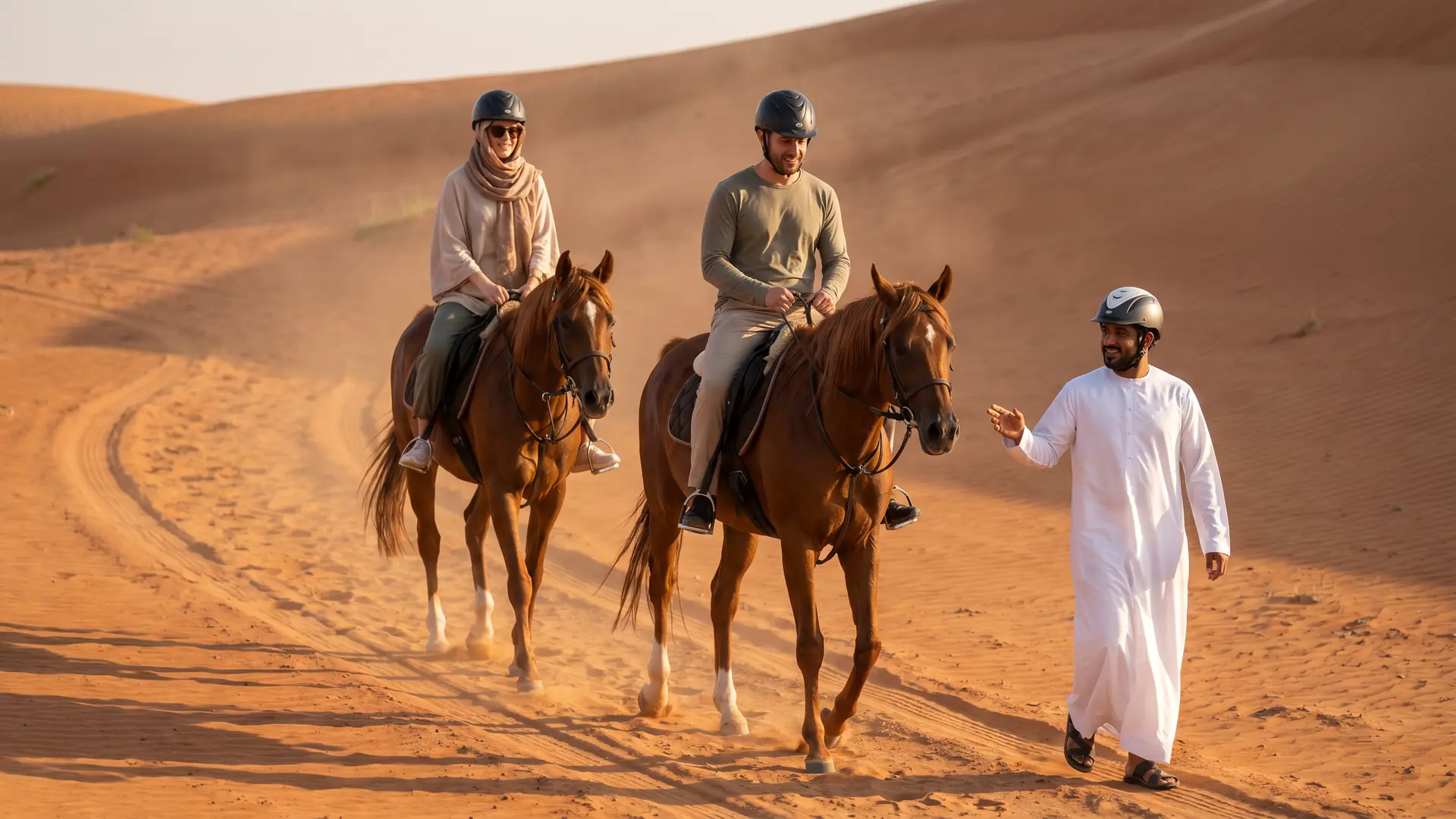
A guided desert trail that suits riders with some saddle time behind them.
These get priced on request rather than listed, since group size, which machines you pick, and how long you want the day to run all shift the number. Message the details on WhatsApp and expect a number back within the day.
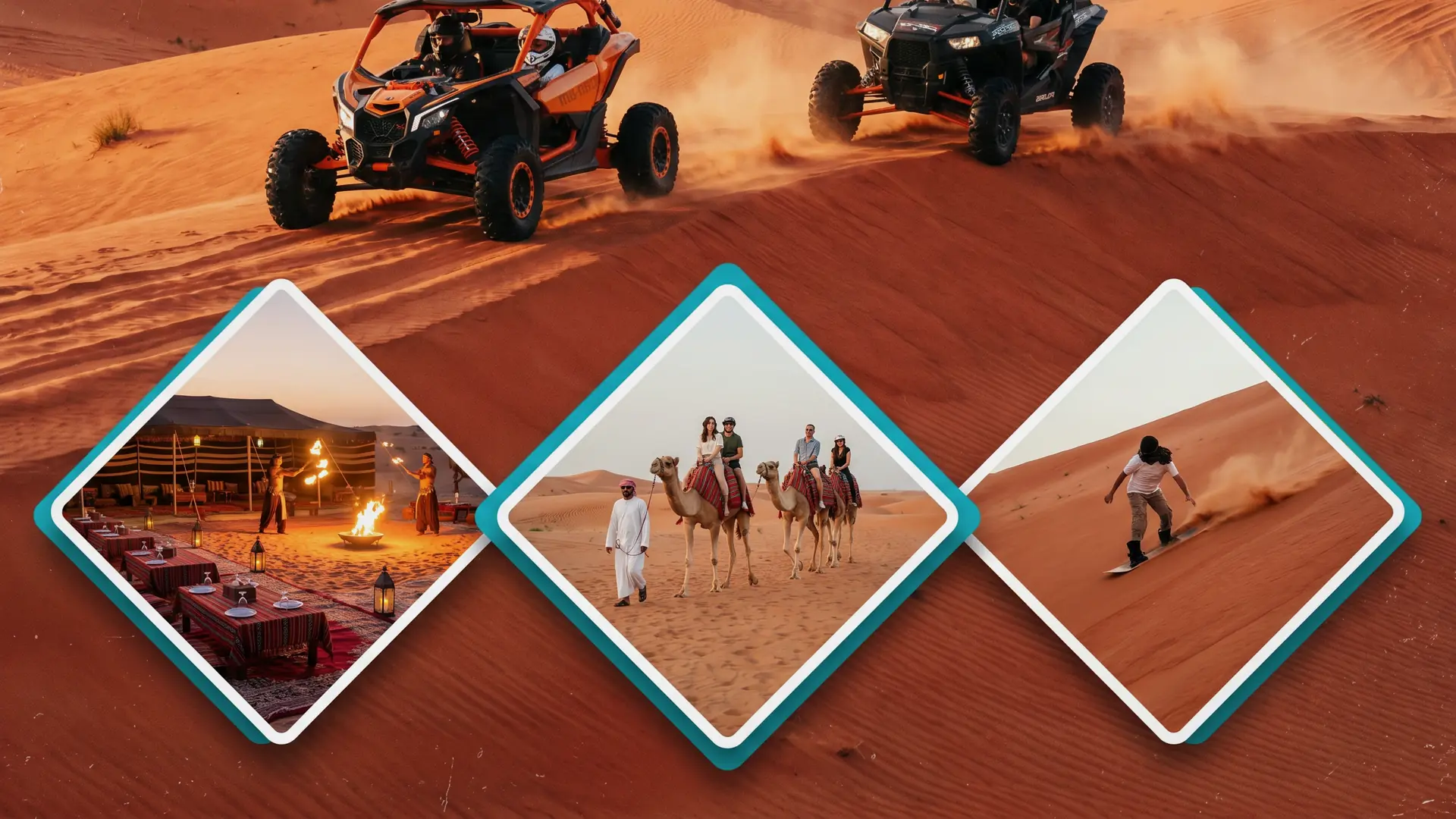
Ride the quad while energy's still high, save the buggy for afterward. Ask on WhatsApp for a number.
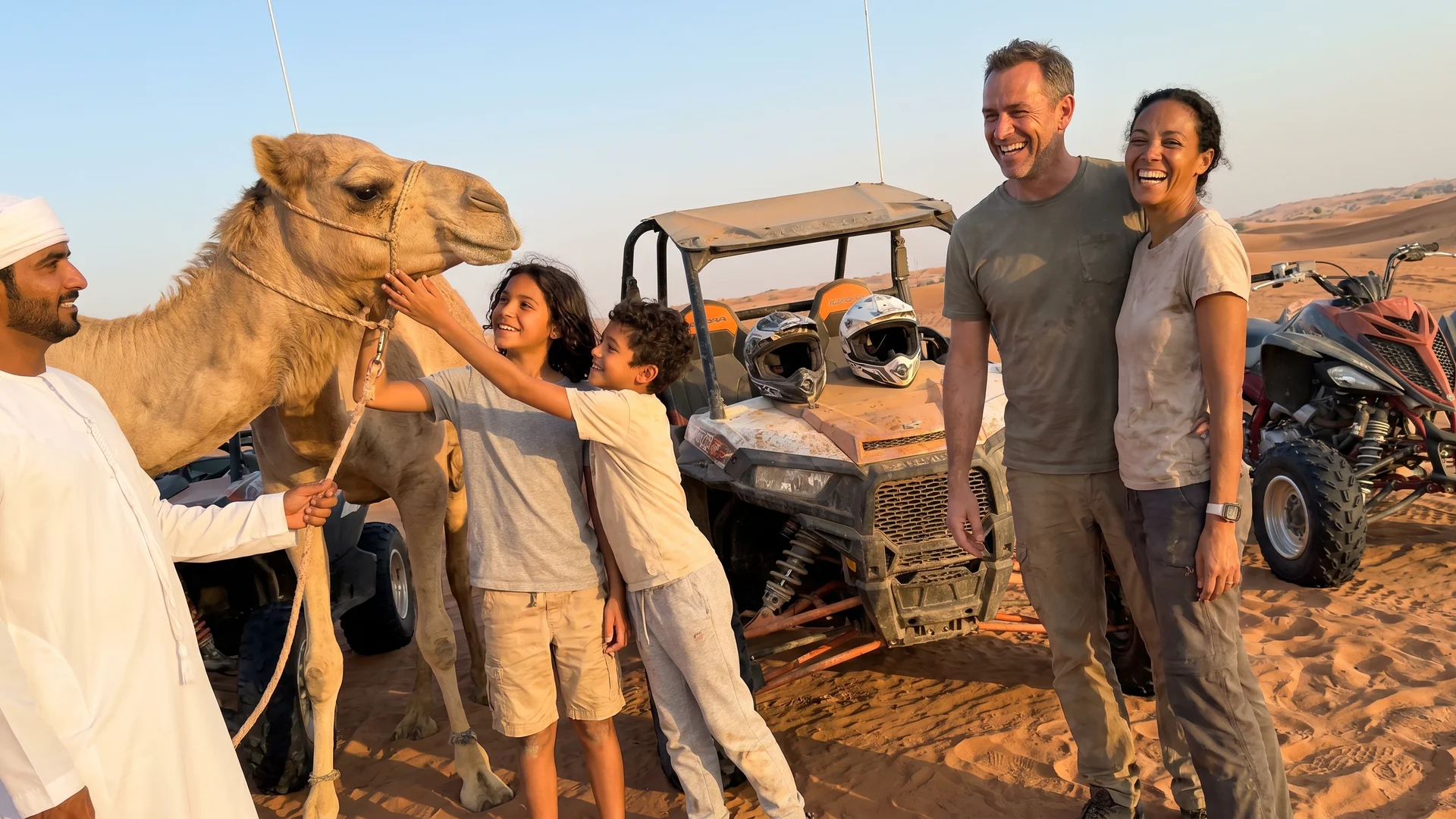
Three different machines split across one family booking, so every generation gets a turn suited to them.
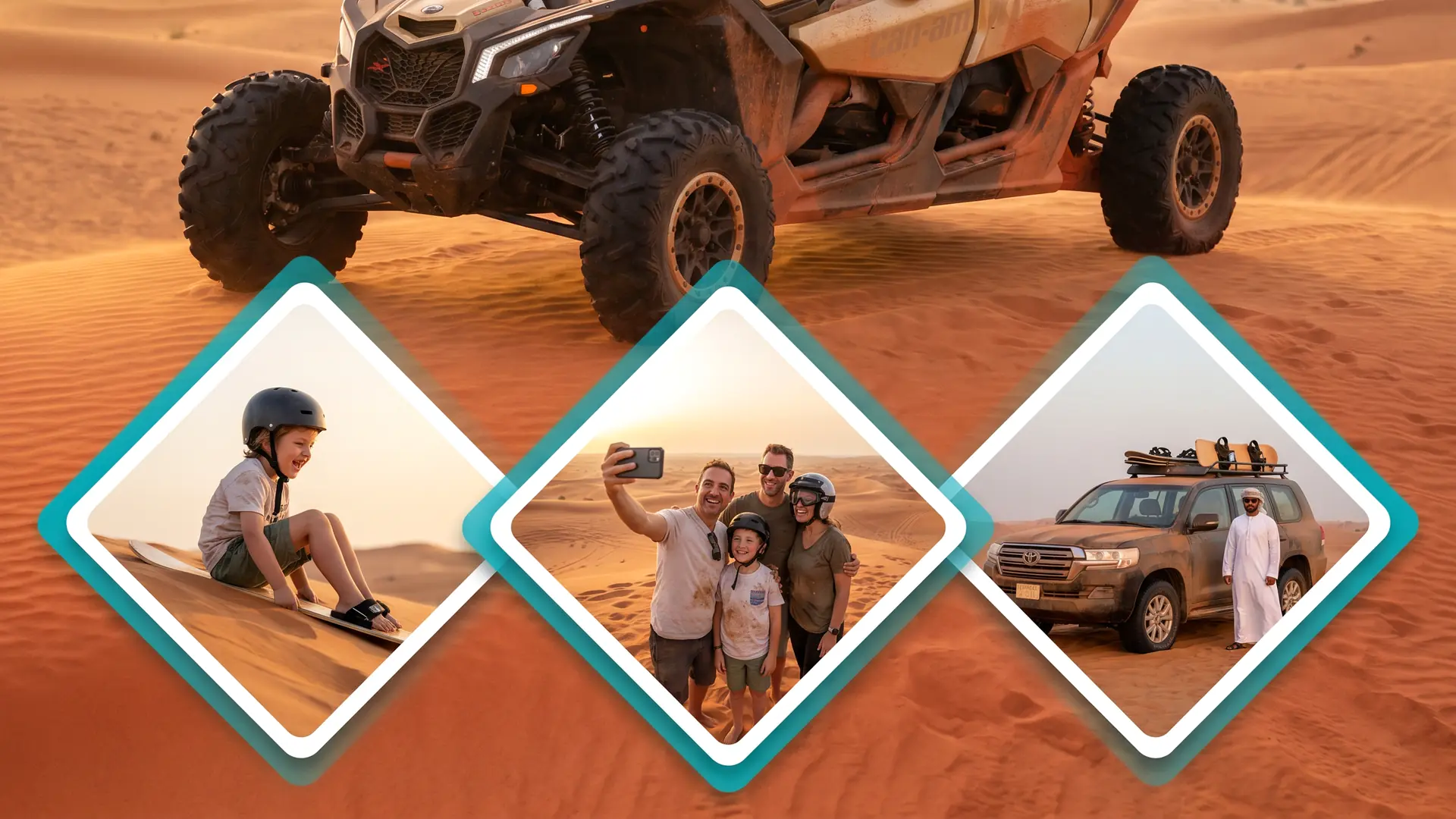
Every machine on this page in a single stretched-out day, quad, buggy, safari and the camp dinner. Priced on request.
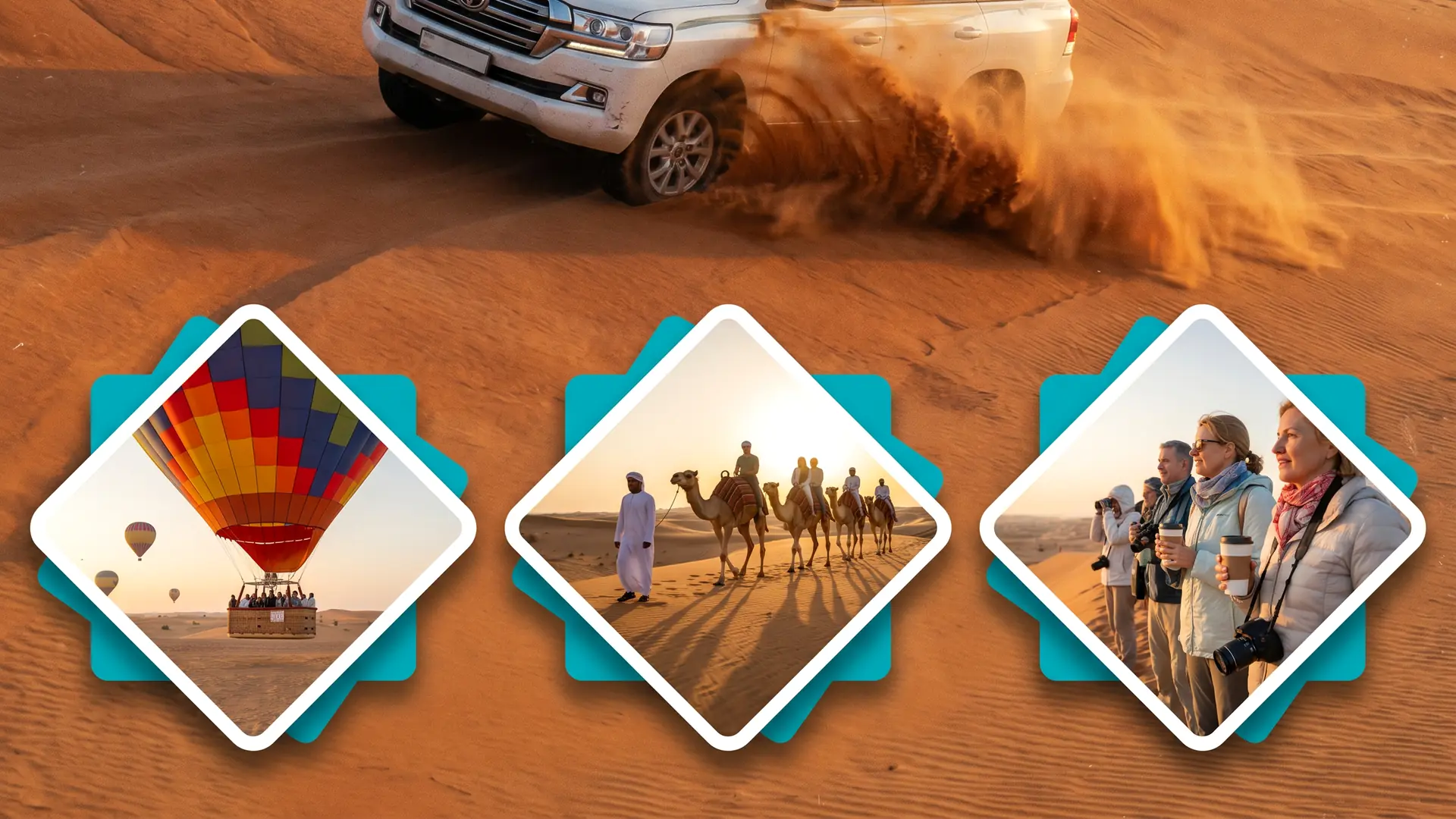
Up in the balloon at first light, back on the ground for dune time once the sun's properly risen. Long day. Good one.
Every ATV, buggy and dirt bike session happens at Al Lahbab, southeast of the city along the Dubai–Al Ain road. The colour alone sets it apart, a deep rust-red rather than the tan most people picture, and the dunes build into genuine bowls instead of the smaller humps nearer town.
The base sits on flat ground, which is exactly where every session starts, warm-up first. That's where a guide reads how you're handling the machine and decides what terrain you're ready for, which is basically the entire safety approach in one move.
Six steps cover it, whether you've booked the short loop or a full afternoon out. Only the middle section gets longer.
A central Dubai hotel is where most riders get collected from, or, for anyone self-driving, directions land once the booking's confirmed.
Helmets go on first. From there it's a rundown of where the throttle and brake sit, how to lean, and the signal that means stop everything.
Flat ground comes first, and a guide is quietly clocking your control of the machine before deciding which route suits you.
The lead guide takes you through the dune bowls and along the ridgelines, pausing here and there for photos.
Back at base for water and a breather, with photos shared before either the ride home or a handoff into anything else on your itinerary.
A dinner package means one more stop after that, straight to the halal BBQ camp.
The supervised 90cc track covers ages nine through twelve, with a guardian on site throughout. Kids younger than that can still join on a camel from age three, or ride along in a buggy while an adult drives. If anything in your group might be a problem, raise it ahead of payment instead of waiting until the briefing, when there's far less room left to adjust plans. Dream Land Adventure Tourism holds the DTCM licence that covers all of this, and once you're out on the dunes, it's the guides who make the final call, every time.
Based on 1,318 Google reviews
Based on 647 reviews
Eight machines span the price list. Cheapest for adults is the 220cc at AED 200; priciest is the Raptor at AED 795, reserved for proven riders; busiest by far is the 400cc sitting between the two at AED 250. A supervised 90cc track takes children nine to twelve at AED 150. Every price is per rider, since it's one person to a machine, with the AED 350 double as the single exception.
No road licence applies here. Al Lahbab is private desert land, not a public road, so registration and road licensing don't come into it. What gets checked instead is your own physical control of the machine, confirmed by a guide during the warm-up before sending anyone at anything steep.
The supervised 90cc track opens at age nine, always with a guardian present on site. Anyone younger can't ride their own machine, but can join a buggy while an adult drives, or take a camel ride starting from age three.
Only the Yamaha 400cc double allows that, with a genuine two-up seat and a single AED 350 fee covering both riders. Every other machine takes one rider only, so don't plan on doubling up elsewhere, it won't be permitted.
Sessions run at Al Lahbab, southeast of the city, which is roughly a 45-minute drive out from Downtown. That's the deep red sand, distinct from the paler, more heavily used sand closer to the highway.
It's an optional add-on, confirmed before you pay. Marina, JBR, Downtown, Business Bay and Deira cover the usual pickup zones. Driving yourself instead? Directions get sent once your booking is confirmed.
Choose a quad for your own machine and steering that leans on body weight. Choose a buggy for a roll cage, a proper wheel, a harness and space for passengers. Plenty of groups book both and switch partway through.
Closed shoes, sunglasses, and clothing you won't mind filling with sand. Helmets are supplied. A scarf or buff over your face helps more than most people expect, and it's worth packing a change of clothes for the ride home.
A guide comes back and gets you moving again. It's treated as a routine part of riding, not a mistake, usually because the throttle got eased off partway up a soft dune face rather than held steady. There's no charge involved.
Yes, provided the 220cc is what you pick and you're upfront during the briefing about never having ridden before. Nobody gets sent at a dune without a guide first watching how they handle flat ground, and riders who need a gentler route are given one without any fuss made about it.
The listed price covers a standard loop through the dunes. Longer routes and multi-activity days get arranged per group, and any combo that folds in a safari or dinner turns the booking into most of an evening. Share your group's details for exact timing.
Most people do exactly that. Nothing else on this page sells faster than the evening safari, quad and BBQ bundle at AED 375. There's a morning equivalent with a quad for AED 290, or drop the dune bashing entirely and pair a quad with dinner alone, where the machine you choose swings the total anywhere between AED 700 and AED 1,300.
A sandstorm or heavy wind moves your slot to a new time rather than cancelling it outright, and that call gets made ahead of time, not at the last minute, with no extra charge attached. Weather has a far bigger say over balloon flights than it ever does over quads.
A few days ahead is usually enough midweek. Weekend slots, Friday especially, deserve at least seven days' notice, and that window stretches even more if the Raptor specifically or several matched machines for a group is the goal. Secure online advance payment locks in the slot.
Quad biking is riding a four-wheeled ATV yourself, controlling throttle and brakes with your own hands rather than sitting behind someone else's wheel. It's practiced worldwide on sand, dirt, mud and rock, and the surface under the tires changes the experience more than the machine itself does. At Al Lahbab, a desert base southeast of the city and about 45 minutes from Downtown Dubai, that surface is fine red dune sand, and eight Yamahas are available to match it: a supervised AED 150 90cc for kids nine to twelve, the AED 200 220cc for total beginners, right up through the AED 795 Raptor 700cc for screened, experienced riders. The AED 250 400cc, roughly in the middle of that range, carries the largest share of bookings.
Most riders extend a session rather than keep it standalone. The package pairing an evening safari, a quad bike and BBQ at AED 375 outsells everything else here, folding dune bashing, a solo ATV run and a camp dinner into one evening. Camel rides, KTM dirt bikes, hot air balloons and dune buggies round out the rest of what the same operator runs, for anyone building a longer day. Secure online advance payment confirms your booking, support available 24/7.
A solo ATV run folded into an evening of dune bashing, dinner waiting back at camp after.
AED 375The machine that lets first-timers actually enjoy the hour instead of surviving it.
AED 200Enough torque for real dunes, forgiving enough for riders still learning.
AED 250The one everyone eventually asks about, and the reason the screening call exists.
AED 795Two people share the machine and the bill, only one throttle hand needed.
AED 350Ages nine to twelve, their own track, an adult watching every lap.
AED 150For riders who already ride, screened first, booked by the hour.
From AED 850Airborne over the same red sand before most of the city wakes up.
AED 1,049The machine barely changes from one place to the next. The ground underneath it does, and that's what actually decides how a session feels. Loose dune sand, packed dirt, mud and rock each demand a different kind of riding.
Picture four riders on the same model of quad in four different countries. One's on hard-packed dirt trails cut through a forest, one's crossing gravel and rock in a quarry park, one's churning through mud after a week of rain, and one's out on loose dune sand. All four would call what they're doing quad biking. None of them would describe the same afternoon if you asked them about it afterward.
Packed dirt and gravel reward speed and commitment, since the tires bite and hold, so momentum works in a rider's favor. Mud flips that logic on its head, because traction disappears the moment you stop moving, and riders learn fast that hesitation is what gets a machine stuck, not boldness. Loose dune sand sits closer to mud than dirt in that respect. It shifts constantly under the tires, which is a large part of why a rider who's only ever done packed trails elsewhere still gets a proper warm-up here rather than being pointed straight at a dune.
Sand itself isn't one single texture either. Beach sand near water tends to be denser and more predictable underfoot than the fine, wind-shaped sand at Al Lahbab, which is drier, looser, and builds into steeper faces than most riders expect from photos alone. That difference has less to do with which country you're in and more to do with how long the wind has had to shape a particular stretch of desert.
None of this means experience elsewhere doesn't help. It clearly does, since throttle control and body position carry over regardless of surface, and a rider who's confident on dirt trails picks things up faster than a total beginner would. What it does mean is that "I've ridden a quad before" and "I've ridden this exact terrain before" are two different claims, and a well-run session is built around the gap between them rather than assuming the two are the same thing.
It's worth asking an operator directly what surface you'll actually be riding on if terrain type matters to your decision, since "desert" alone covers everything from firm, wind-packed flats to steep, loose dune faces, and the two ride nothing alike even though both would fairly be called sand.
None of this is a reason to inflate or downplay experience when a guide asks about it, either. Riders occasionally describe themselves as advanced because of one trail ride years ago, or as complete beginners despite years of dirt biking on a different machine, and both misjudgments tend to land someone on the wrong quad. The more useful question isn't "have you ridden a quad," it's "how recently, how often, and on what kind of ground," and a fuller answer gets a rider matched to something that actually fits what they can do today rather than what they used to do.
A holiday session hands you a machine, a guide and roughly an hour. Treating quad biking as a hobby means owning or regularly renting equipment, riding familiar terrain often enough to stop thinking about the basics, and usually chasing more technical ground on purpose.
Almost everyone booking a quad on a trip to Dubai is doing the tourist version, and that's exactly what the format is built for. You don't own a machine, you're not committing to a season of riding, and the whole point is a contained, guided couple of hours that fits neatly into a wider holiday. None of that makes it a lesser version of the activity. It's simply solving a different problem than what a dedicated rider is solving.
Hobbyists tend to own or lease their machine, maintain it themselves, and return to the same local trails often enough to notice small changes, a rut that wasn't there last month, a line that's gotten looser since the last rain. They're usually chasing a specific kind of terrain on purpose too, motocross tracks, rock crawling, organized desert races, rather than a general introduction to the sport. The cost structure shifts accordingly, from a single session fee to ongoing ownership: fuel, servicing, storage, and often club membership or race entries stacked on top.
The two worlds do overlap occasionally. A rider who tries a guided session and wants more of it usually moves toward bigger, more demanding machines on a return visit rather than buying equipment outright, which works as a reasonable middle step before deciding whether the hobby side is actually worth the investment of owning something.
What doesn't change between the two is the core skill underneath it. Throttle control, reading the ground ahead, weighting the machine correctly through a turn, all of it transfers directly whether you're on a guided desert loop or racing a private track on the weekend. A single well-run tourist session teaches roughly the same fundamentals a hobbyist builds on over years, just compressed into an hour instead of spread across a season.
Getting into the hobby side properly also means a learning curve most tourists never see. Maintenance becomes its own skill: air filters clogged with sand, chains needing regular tension checks, tires that wear unevenly depending on which terrain gets ridden most. None of that touches a rental customer, since the operator absorbs it entirely behind the scenes, but it's a real, ongoing cost of the hobby version that rarely gets mentioned alongside the more exciting parts, the races, the trail days, the upgraded suspension people post about online.
It depends entirely on where the riding happens, not on quad biking as an activity. Public roads usually require registration and a licence. Private land and guided operations almost never do, and that's the category a tourist session falls into.
The rule that actually governs this isn't about the sport, it's about the ground underneath it. Ride a quad on a public road anywhere and you're generally into vehicle registration, insurance and a driving licence, the same as any other motor vehicle, because you're sharing space with regular traffic. Ride on private land instead, a rental operation, an off-road park, a farm, and licensing requirements mostly disappear. What replaces them is usually a signed waiver, a minimum age, and sometimes a short safety briefing before anyone's handed the keys.
Some countries add their own layer on top of that baseline. A handful require an off-road vehicle permit even on private land once you're above a certain engine size, and a few make helmets a legal requirement regardless of where the riding happens. None of it is universal, and it's genuinely worth a quick check before renting somewhere unfamiliar, since the honest answer changes by country and sometimes by state or emirate within one country.
Dubai's version of this is fairly simple. Sessions run entirely on private desert land at Al Lahbab, never on a public road, so a UAE driving licence plays no part in the process. The real gatekeeper shows up during the flat-ground warm-up, where a guide informally reads how well you're controlling the machine before anything steep gets attempted. There's no written test involved, no certificate issued afterward, and no paperwork to arrange before you arrive.
Private land doesn't mean unsupervised, though. A lead guide sets the route and pace for the entire group, spacing between riders is deliberate rather than accidental, and the fleet itself is age-gated, nine and up for the supervised 90cc track, with adult machines assumed for anyone older than that. It's a looser system than a road licence would be, but it isn't an unregulated one either.
Age minimums follow a similarly patchwork pattern to licensing worldwide. Some countries set a hard legal minimum for any ATV riding regardless of supervision, others leave it entirely to the operator's own policy, and a few distinguish between engine sizes, allowing smaller machines at a younger age than larger ones. There's no single global standard worth memorizing, which is exactly why checking directly with wherever you're booking matters more than assuming a rule from one country carries over neatly to the next.
All three get filed under the same "adrenaline activity" heading on most trip itineraries, but they ask very different things of the person doing them. Quad biking demands the most sustained physical involvement of the three, and the most active decision-making throughout.
A zip-line is the most passive of the three despite feeling like the fastest. You're clipped in, gravity and a cable do the actual work, and the job is mostly holding a position and taking in the view. There's very little skill to build and almost no way to influence the ride once you've stepped off the platform. Each run is short, usually a couple of minutes, and repeatable without much variation between one go and the next.
Jet skiing sits in the middle of the three. Steering and speed control are genuinely yours, so there's a real skill component involved, but the machine forgives mistakes in a way a quad simply doesn't, water absorbs a wrong decision far more gently than sand or dirt ever will. Sessions also tend to run shorter and more repetitive, looping a marked course rather than covering new ground with every pass.
Quad biking asks for sustained physical involvement for the length of a whole session rather than a burst of it. You're actively managing throttle, brakes and body position the entire time, the terrain shifts constantly instead of looping a fixed course, and a wrong decision has real, if usually low-stakes, consequences: a stuck machine, an awkward dismount, a rougher landing than planned. It's also the most physically tiring of the three afterward. Arms and core do genuine work over an hour in a way an afternoon of zip-lining just doesn't demand.
None of that makes it objectively better. It makes it a different category of adrenaline, sustained and skill-based rather than a short, engineered burst someone else has built for you. Riders who found a zip-line fun but quickly forgettable tend to find a quad session sticks with them longer, mostly because they were doing something the whole time instead of experiencing something that was largely done to them.
Cost tends to track the effort involved too, though not perfectly. A zip-line run is typically the cheapest of the three and the fastest to complete, which suits a quick stop wedged between other plans. Jet skiing sits roughly in the middle on both price and time commitment. Quad biking usually asks for the longest block of a day and carries the highest price of the three, which lines up with the equipment, fuel, guide time and briefing involved, and it's worth weighing that against a tight schedule or a fixed activity budget before picking between them.
Awkward, not exciting, and knowing that going in tends to help more than any amount of reassurance does. The real dune riding doesn't start until after a flat-ground warm-up, so there's a buffer before anything demanding is asked of you.
Minute one is a helmet that feels tighter than expected and a machine that looks bigger sitting on it than it did parked nearby. Minutes two and three are the briefing, throttle on the right, brake on the left, lean forward going up a face, sit back coming down one, and most first-timers retain maybe half of it on the first pass through, which is completely normal and exactly why nobody gets sent straight at a dune afterward.
The actual first movement, usually minutes four through six, is the part people brace hardest for and then find almost anticlimactic. The machine creeps forward at a crawl on flat sand, steering feels heavier than a bicycle but noticeably lighter than a car, and the throttle responds to a far lighter touch than the grip itself suggests it should. Most beginners over-correct at first, easing off more than the moment actually calls for, then settle into a more natural hand position within a few minutes of riding.
By minutes seven through ten, still on that same flat stretch, a guide is usually already reading how someone's doing: hands gripping too tight, sitting too far forward, holding the bars like a bicycle rather than resting on them, and making small corrections without ever turning it into a lecture. This is roughly when the nervousness most people arrive with starts to fade too, replaced by the far more manageable feeling of concentrating on a task instead of dreading one.
What doesn't happen in the first ten minutes is a real dune. That comes only after the warm-up, once a guide has actually watched how a particular rider handles the machine on flat, low-stakes ground. Anyone who arrives expecting to be climbing sand within minutes of arriving is usually relieved, not disappointed, to discover there's a buffer built in before any of that starts.
What happens in minute eleven and beyond depends entirely on how those first ten went. A rider who's clearly settled moves toward the base of the first proper dune fairly soon after, still on a short, forgiving line. A rider who's still tense or over-correcting gets more time on the flat stretch, sometimes without ever being told outright that's what's happening, since turning it into an obvious delay would undercut the point of it. Either way, nobody's first real dune happens in isolation. A guide stays close by, watching that first attempt as carefully as the warm-up itself, ready to adjust the next stretch of route based on what they see.
Both work, which is fairly unusual for an activity built around individual machines. You're never physically sharing a quad the way you'd share a jeep or a boat, so group size barely changes what any one rider actually does. It mostly changes the atmosphere around it.
Solo, the appeal is straightforward. Nobody's pace but your own, no coordinating schedules with anyone else, and a guide's attention isn't split between reassuring a nervous partner and reining in an overexcited one at the same time. It suits travellers with a free afternoon between meetings, or anyone who'd rather concentrate quietly while they're still finding their balance on the throttle.
In a group, the machine stays personal but the experience turns shared, comparing notes at the water stop, someone's slightly-too-fast climb becoming the story of the trip later, photos taken of each other instead of just the scenery. Families and groups of friends make up the more common booking by a wide margin, and sessions are built around exactly that, keeping the group loosely together on one route while still giving each rider their own machine and their own pace within it.
A solo traveller booking here doesn't need to arrange a private session to make it work either. You're simply folded into whichever group already has that time slot, and a guide runs the same warm-up and route regardless of whether it's one rider that day or eight. The main difference solo riders actually notice is that conversation at the water break happens with strangers instead of travel companions, which more people end up enjoying than expect to going in.
Couples occupy an interesting middle ground between solo and group. Two riders on two separate machines get the shared-experience benefit, comparing notes afterward, splitting photo duty, without needing a larger group's coordination or scheduling around it. It's also common for one partner to want the throttle and the other to prefer watching from the safari vehicle instead, and that split is handled easily, since a session works fine with an uneven mix of riders and non-riders moving through it together.
Larger private groups, corporate outings, birthday parties, extended family visits, are scheduled on their own dedicated timing instead of joining a slot someone else already booked, mainly because a bigger cluster of machines moving together changes the pace and spacing needed. Worth mentioning your group size when booking either way, since it's one of the few things that genuinely changes how a session gets run.
Depends entirely on climate, and for opposite reasons depending on where you are. Cold climates lose riding season to snow and frozen ground. Hot desert climates lose comfortable riding hours to heat instead, not the calendar itself.
In temperate regions, quad biking genuinely runs close to year-round, adjusted for mud and rain rather than shut down outright for months at a time. Snowier regions see a harder seasonal cutoff, sometimes swapping quads for similar snow-capable machines instead of stopping entirely. Desert operations face a different limit altogether: the sand itself doesn't shift with the seasons, but comfortable riding hours shrink dramatically once peak summer heat sets in.
Dubai falls into that last category. Sessions run every single day of the year, there's no month where Al Lahbab simply shuts down, but when you ride matters here far more than it does somewhere temperate. October through April, riding happens comfortably across most of the daylight hours. Through the peak summer months, sessions shift almost entirely to early morning or the couple of hours before sunset, working around the harshest midday heat rather than cancelling because of it.
That makes booking a session here in August meaningfully different from booking one in January, not in what you'll actually do, but in what time you'll be asked to show up. A January booking has flexible timing across most of the day. An August booking is going to land near sunrise or late afternoon, and that's worth building into travel plans ahead of time rather than discovering it only once you're confirming dates.
Weather within a season adds a separate, shorter-notice layer on top of all this. Sandstorms and strong wind can move a single booked session regardless of what month it happens to be, which is a distinct issue from the broader seasonal pattern and gets handled by rescheduling to the next available slot rather than by avoiding entire months altogether.
Booking behavior shifts with the seasons too, not just riding hours. The cooler months, especially December through February, are when demand peaks and slots fill fastest, particularly on weekends, mainly because more visitors are choosing to travel then specifically for outdoor activities. Summer bookings, by contrast, often have more same-week availability, precisely because fewer people plan outdoor-heavy itineraries then, even though the sunrise and late-afternoon slots that do run are just as complete a session as anything booked in January.
Not in the extreme-sports sense of the phrase. It sits closer to horseback riding or skiing on the risk scale than to something like BASE jumping, real physical engagement with genuine but usually minor consequences for mistakes, managed down by guides, warm-ups and machines matched to a rider's experience. Most reported injuries industry-wide are minor, sprains or bruises from a low-speed tip rather than anything more serious.
Both exist. Unguided rentals are common at some off-road parks abroad, where you sign a waiver and loop a marked course alone. Guided sessions, where a lead rider sets the route and pace for the whole group, are the norm on private desert land like Al Lahbab, and are generally the safer default for anyone riding unfamiliar terrain for the first time.
Mostly interchangeable in everyday use. ATV, all-terrain vehicle, is the formal term, quad refers specifically to the four wheels, and four-wheeler is common informal usage for the same machine in American English. All three describe the straddle-seat, handlebar-steered vehicle used here, as opposed to a side-by-side buggy, which has a steering wheel and bucket seats instead.
No specific fitness level is required for the standard adult machines, and the 220cc is deliberately forgiving for exactly this reason. Core and arm strength matter more on higher-powered machines like the Raptor 700cc or the sports quad, since they demand more physical input at speed. Anyone with real doubts about stamina is better placed on a gentler machine than skipping the activity altogether.
Engine noise is comparable to a motorbike, noticeable but not extreme, and sessions stay within a defined area of desert rather than roaming open, undisturbed land. It's louder than a camel ride and quieter than a dirt bike or a larger-engined dune buggy. Operators generally avoid riding the same patch of dunes repeatedly in one day to limit visible track wear.
Yes to both. Standard glasses fit under most open-face and full-face helmets, though a snug frame sits more comfortably than a wide one. Contact lens wearers should expect more dust exposure than glasses wearers and may want rewetting drops on hand, since desert riding is genuinely dustier than most other activities on a typical trip.
Competitive quad biking, usually organized under ATV or quad-cross categories, runs regionally rather than under one single global body, with motorsport federations in various countries running their own off-road and ATV racing series. Recreational riding, the kind covered on this page, isn't federation-regulated at all. It's governed by whoever owns or operates the land you're actually riding on.
Operator liability coverage is standard practice and typically built into the session price rather than sold as an add-on, covering the guided activity itself. It doesn't replace personal travel insurance, and anyone planning higher-speed machines like the Raptor or the sports quad should check their own travel policy actually covers off-road or adventure activities, since some exclude them by default.
Death-gripping the handlebars and going rigid through the arms and shoulders, rather than staying loose. It sounds minor, but a stiff rider transmits every bump straight into their own body and reacts more slowly to a shifting line, while a relaxed grip actually absorbs the terrain and makes correcting course noticeably easier.
Yes, and it's a more common starting point than people expect. A quad doesn't lean into a turn the way a motorbike does, both wheels stay planted through most maneuvers, and there's no clutch or gear-balancing act to manage. Riders who've avoided motorbikes specifically because of the balance and lean angle often find a quad far less intimidating once they're actually sitting on one.
Choose the machine you want, pay online today to hold the slot, then watch for a WhatsApp message the evening before confirming your exact pickup time.